
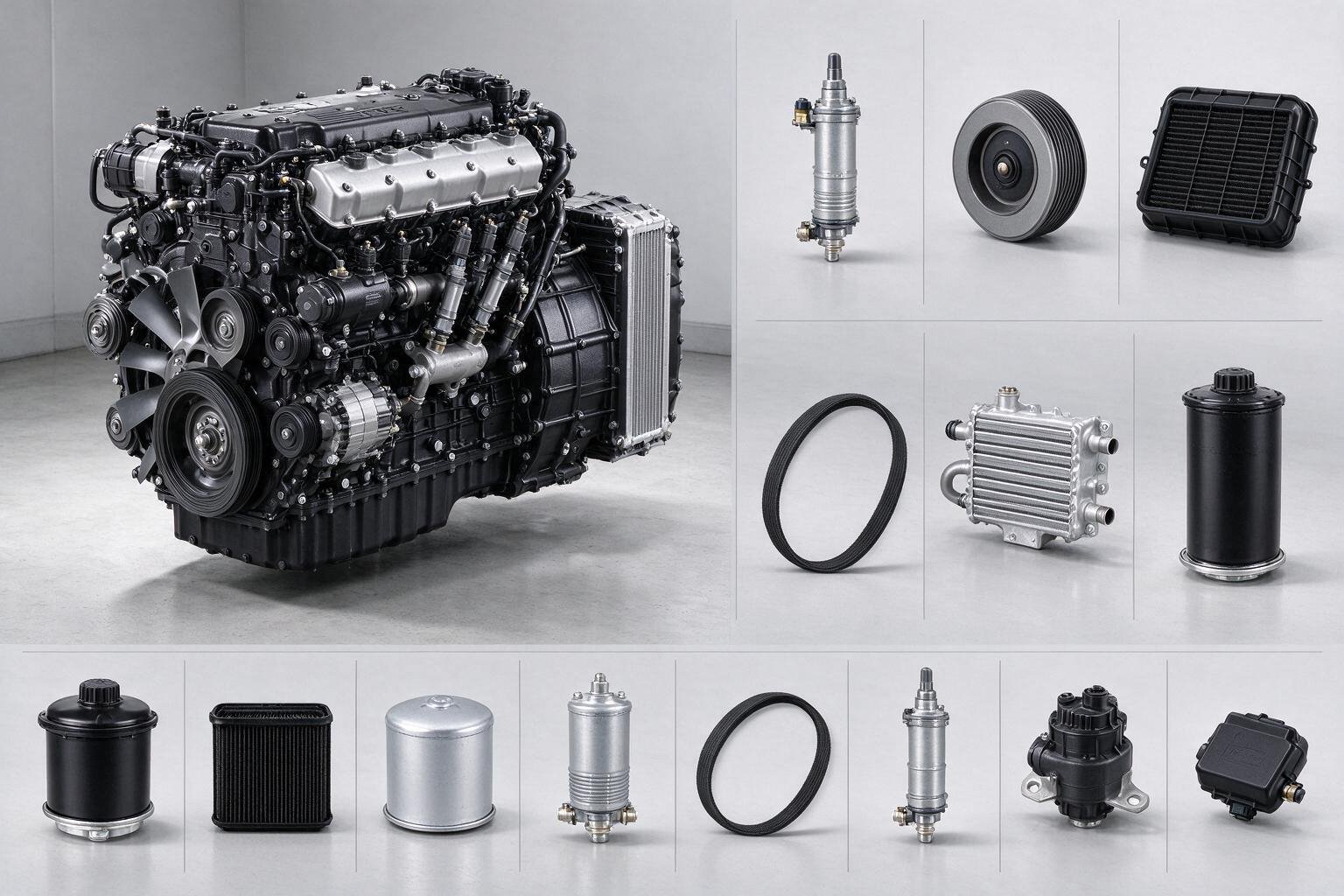
This Cummins ISX15 engine parts buying guide begins with the platform itself: a 15-liter inline-six diesel used in heavy-duty trucks and vocational equipment. Production spans multiple emissions generations, and the platform was revised repeatedly to meet changing regulations, so the same displacement does not mean the same parts. Major configurations include the CM570 (2002-2006, covering pre-EGR and early EGR builds), the CM871 (2007-2009), the CM2250 (2010-2013), and the CM2350 (2013 and later). Each control module generation changed the cylinder head, injectors, turbocharger, EGR system, and aftertreatment hardware. Components from one generation often do not fit or function correctly on another, even when they appear similar.
How to Read Cummins Part Numbers
Cummins part numbers are typically seven digits, sometimes followed by a suffix or revision letter. The base number identifies the part family, while the suffix or revision indicates a change in specification, material, or supplier. Reading the base number first narrows the search to the correct component group before any suffix is evaluated.
A single functional part can carry multiple numbers. An engineering number may appear in service literature, a service part number is what a dealer or distributor sells, and a kit number bundles the part with related hardware such as gaskets, seals, or fasteners. Buyers should confirm which number type a listing refers to, because ordering an engineering number does not always produce a shippable part.
Supersessions are common on the ISX15. An older number may be replaced by a newer one that fits the same application, and a reputable supplier should state the current number alongside any superseded number. CPL-specific differences appear in injectors, pistons, camshafts, and turbochargers even when the base part number looks similar, so the CPL must be confirmed before ordering.
| Number Type | Purpose | Buyer Action |
|---|---|---|
| Engineering number | Internal design reference | Do not order on this alone |
| Service part number | Current sellable part | Confirm against engine CPL |
| Kit number | Part plus related hardware | Check kit contents |
| Superseded number | Replaced by a newer number | Request the current number |
Aftermarket numbers should be cross-referenced to the Cummins service number, and CPL fitment confirmed rather than relying on the aftermarket number alone.
High-Wear Parts and Typical Replacement Intervals
Wear patterns on the Cummins ISX15 vary by emissions configuration, duty cycle, and maintenance history. The intervals below are general guidance; actual replacement should follow inspection findings and the OEM service manual for the specific engine rating and calibration.
Injectors. On CM871 and later engines, injectors are a frequent replacement item. Condition is typically judged by return flow testing rather than mileage alone, since fuel quality, filtration, and duty cycle affect wear rates significantly. Engines with elevated return flow, rough idle, or fuel dilution symptoms warrant testing regardless of hours accumulated.
Turbochargers, EGR coolers, and EGR valves. These are common failure points on 2007 and later emissions configurations. EGR cooler leakage and valve sticking are progressive conditions; coolant loss, white exhaust smoke, or fault codes should prompt inspection before secondary damage occurs.
Cylinder head components. Valves, seats, and guides are generally addressed at major overhaul rather than as routine service. Inspecting them earlier is reasonable when a head is removed for another reason, but scheduled replacement is not typical.
Liners, pistons, and rings. These are replaced as a matched set at overhaul. Mixing wear levels across cylinders is not recommended, as uneven bore geometry and ring seating can affect compression balance and oil consumption.
Water pumps, thermostats, and oil coolers. These are service items with defined inspection points at PM intervals. Coolant condition, weep hole evidence, and temperature stability are the usual check criteria.
| Component | Typical Trigger for Replacement |
|---|---|
| Injectors (CM871+) | Return flow test results, drivability symptoms |
| Turbocharger | Boost loss, oil passage, shaft play |
| EGR cooler / valve | Leakage, sticking, fault codes |
| Head components | Major overhaul |
| Liners / pistons / rings | Overhaul, as a matched set |
| Water pump / thermostat / oil cooler | PM inspection findings |
Intervals should always be reconciled against the engine’s actual service documentation.
Genuine, OEM-Supplier, and Aftermarket Parts Compared
Genuine parts are supplied through the Cummins distribution network and carry the Cummins brand and packaging. This channel provides traceability to the manufacturer’s part number and, for emissions-related components, documented conformity to the specification the engine was certified against. Buyers should note that the Cummins name on the box refers to the distribution source, not to the entity selling the part.
OEM-supplier parts are produced by the same tier-one manufacturers that supply Cummins, sometimes without Cummins branding. The part may be dimensionally and materially identical to the genuine item, but this cannot be assumed from appearance alone. Documentation of the source matters: a supplier name, a manufacturer part number, and a traceable production record distinguish a true OEM-supplier part from a counterfeiter’s claim. Without that paperwork, the OEM-supplier category offers no verifiable advantage over a well-documented aftermarket part.
Aftermarket parts vary widely in quality. Buyers should request material specifications, testing records, and warranty terms before committing to a supplier. For emissions-related components such as EGR coolers, DPF assemblies, and SCR dosing units, aftermarket parts must meet the same functional requirements as the original, and buyers in regulated markets should confirm compliance with the applicable standard rather than relying on a supplier’s general assurance.
Cost differences are largest on injectors, turbochargers, and cylinder heads, where remanufactured options also exist alongside new genuine, OEM-supplier, and aftermarket parts. Remanufactured units should be evaluated on the core acceptance criteria, the replacement parts used, and the warranty duration relative to a new unit.
| Category | Branding | Key Buyer Check |
|---|---|---|
| Genuine | Cummins packaging | Part number traceability |
| OEM-supplier | Often unbranded | Source documentation |
| Aftermarket | Supplier-specific | Material specs, test records, warranty |
| Remanufactured | Varies | Core criteria, warranty terms |
Remanufactured and Used Parts: What to Verify
Remanufactured and used components can reduce repair cost on an ISX15, but the savings depend on documentation and inspection discipline. Buyers should treat verification as part of the purchase, not an afterthought.
Injectors and Turbochargers
Remanufactured injectors should arrive with a test report showing flow and balance results against the applicable specification. For turbochargers, request a report covering boost performance and, where available, shaft balance. A unit without test data offers no evidence that it will meter fuel or build boost within the calibration window the ECM expects.
CPL Family Matching
The ISX15 was built in multiple configurations identified by CPL (Control Parts List). Ask whether the remanufactured unit was built for the same CPL family as the engine it will serve. A reman injector or turbo assembled for a different CPL may not calibrate correctly, and the mismatch can surface as rough running, derate events, or poor fuel economy after installation.
Used Cylinder Heads and Blocks
Used cylinder heads and blocks should be checked for cracks, deck flatness, and evidence of prior machining before acceptance. Magnetic particle or pressure testing on heads, and flatness checks on decks, establish whether the part is serviceable. Prior machining that exceeds specification limits can affect compression ratio and head bolt torque.
Warranty and Core Terms
Warranty terms on remanufactured parts typically differ from new: confirm duration, coverage scope, and the claim process in writing. Core charges and return shipping terms affect total cost and belong in any quote comparison.
| Item to verify | What to request |
|---|---|
| Injector test data | Flow and balance report vs. specification |
| Turbo test data | Boost performance report |
| CPL match | Build CPL family confirmation |
| Used head or block | Crack test and deck flatness results |
| Warranty | Duration, scope, claim process in writing |
| Core | Charge amount and return shipping terms |
Inspection Checklist on Receipt
Every Cummins ISX15 part should be verified against the order and the engine before it enters inventory or the service bay. The steps below apply to new and remanufactured components alike.
Identification and Documentation
Match the part number and CPL (Control Parts List) on the label to the purchase order and to the engine ESN (Engine Serial Number). A CPL mismatch can indicate a superseded or incorrect-specification part, particularly for injectors, fuel pumps, and aftertreatment components where calibration varies by rating. Confirm that any supersession noted on the label is documented on the invoice.
Packaging and Condition
Inspect the carton for crush damage, moisture intrusion, or broken seals. Open and examine the part for corrosion, debris, or handling marks on sealing surfaces, threads, and connector pins. Do not accept a part that shows evidence of prior installation, such as torqued fastener marks or disturbed thread sealant.
Component-Specific Checks
| Component | Check |
|---|---|
| Injectors | Calibration/trim code present and legible; confirm the trim code can be entered into the ECM before installation |
| Turbochargers | Actuator type (electronic vs. wastegate) and clocking/orientation match the original unit |
| Fuel pumps | Part number and CPL consistent with ESN; ports capped and free of debris |
Record Keeping
Record all serial numbers and take photographs of the label, packaging, and part at receipt. These records support any warranty claim and document condition at the point of delivery. Retain them with the repair order.
Sourcing Checks for B2B Buyers
Purchasing parts for the Cummins ISX15 requires verification steps that go beyond matching a model name to a catalog listing. The following checks reduce the risk of receiving incorrect or undocumented components.
Parts lookup by ESN and CPL. The ISX15 was produced across multiple configurations, and the engine serial number (ESN) and control parts list (CPL) determine the correct part for a given build. Buyers should ask whether the supplier can look up parts using the ESN and CPL rather than the model name alone. Suppliers who can cross-reference these identifiers are better positioned to supply the correct variant.
Stock status and lead time in writing. Confirm availability and expected lead time in writing before issuing a purchase order. This matters most for emissions components, such as aftertreatment and dosing-related parts, which can carry extended lead times. Written confirmation provides a reference point if delivery dates slip.
Traceability documentation. Request records identifying the manufacturer, lot or serial number, and test records where applicable. For remanufactured assemblies, documentation should indicate the remanufacturer and the tier of the rebuild.
Like-for-like quote comparison. Compare quotes against the same part number and condition grade. A lower price frequently reflects a different reman or aftermarket tier rather than a better deal on an equivalent part.
| Check | What to request |
|---|---|
| Identification | Lookup by ESN and CPL |
| Availability | Written stock status and lead time |
| Traceability | Manufacturer, lot or serial, test records |
| Comparison | Same part number and condition grade |
| Cross-border terms | Incoterms, duties, return policy |
Cross-border terms. Clarify Incoterms, duty responsibility, and the return policy for international orders. Return windows and restocking terms vary, and unresolved terms can offset any price advantage.
Common Buying Mistakes to Avoid
Ordering by model year without the CPL
The ISX15 was produced in multiple configurations, and model year alone does not identify the correct hardware. The Critical Parts List (CPL) number stamped on the engine dataplate defines the specific injector, turbocharger, and related components fitted at build. Ordering by year can yield an injector with the wrong flow rating or a turbocharger with a mismatched wastegate or VGT actuator, producing driveability complaints and repeat labor. The CPL should be confirmed before any major component order is placed.
Assuming ISX15 parts fit ISX or QSX15 applications
The ISX15, ISX, and QSX15 are related platforms but not identical. Injectors, turbochargers, and certain front gear train and cooling components differ in part number and specification across these families. Interchange claims should be verified against the engine serial number and CPL, not assumed from family resemblance.
Buying the lowest-cost aftermarket injector without flow test data
Low-cost aftermarket injectors are frequently sold without documented flow testing. An injector that is not flow-matched to specification can cause rough running, imbalance codes, and shortened service life. Request flow bench data with the part number and serial traceability before purchase; the savings are often offset by a second repair.
Skipping ECM calibration after injector replacement
Injector replacement on the ISX15 typically requires an ECM calibration or injector trim update. Omitting this step can produce poor running, hard starts, and active fault codes even when the hardware is correct.
Ignoring core return deadlines
Remanufactured injectors, turbochargers, and pumps carry a core charge. Missing the supplier’s return window forfeits the core credit, which can add several hundred dollars per unit to the job cost. Core deadlines and return shipping terms should be confirmed at the time of order.