
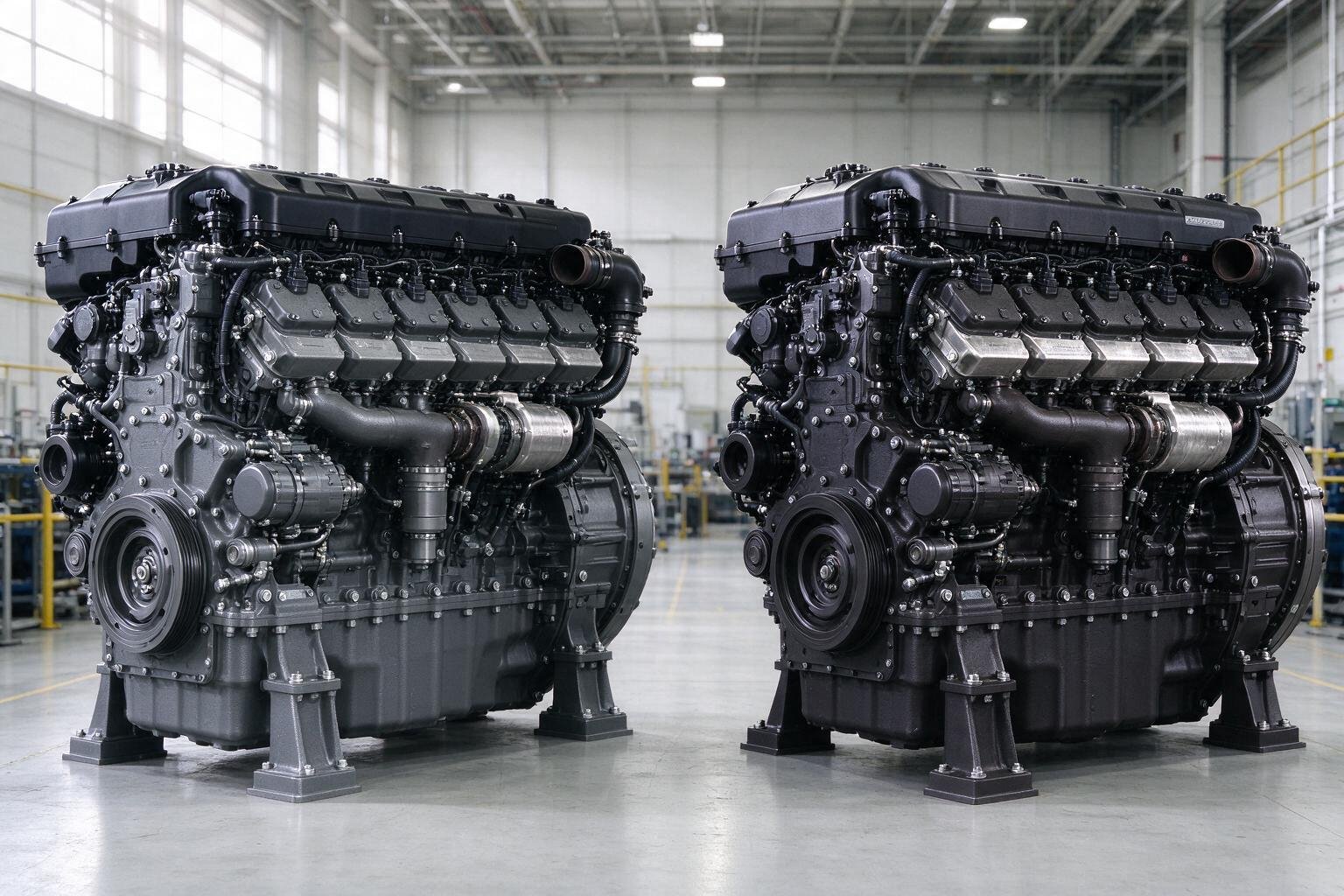
A Cummins QSK19 engine assembly supplier comparison begins with the engine itself: a 19-liter, inline six-cylinder heavy-duty diesel used across mining haul trucks, locomotives, marine propulsion, and power generation. Because the same displacement serves these very different duty cycles, assemblies vary significantly by rating, emissions tier, and application, so buyers conducting a Cummins QSK19 engine assembly supplier comparison should establish the exact configuration before evaluating price.
The term “engine assembly” is not standardized across the aftermarket. Suppliers may quote a complete drop-in engine with accessories and harness, a long block with cylinder head and internals but no external components, or a short block covering the block, crankshaft, and pistons. Scope differences of this magnitude can exceed the price gap between competing quotes, so the bill of materials must be confirmed line by line before any comparison is meaningful.
Common configurations include QSK19-C ratings for mining and construction equipment, QSK19-M ratings for marine propulsion, and QSK19-G ratings for generator drive. The CPL (Control Parts List) number defines the exact build of a given engine, including fuel sys
Supplier Categories in the QSK19 Aftermarket
The Cummins QSK19 aftermarket is served by four broad supplier categories, each with distinct commercial and technical characteristics. Buyers comparing assemblies should evaluate warranty terms, documentation, and traceability alongside price.
Authorized Cummins Distributors
Authorized distributors supply new assemblies and Cummins ReCon remanufactured units. These carry a factory warranty and are built to a specific CPL (Critical Parts List), so injectors, pistons, and other components match the original configuration. Documentation is complete, including build records and serial traceability. This category typically sits at the highest price point, reflecting the warranty and factory-backed parts content.
Independent Remanufacturers
Independent remanufacturers rebuild core engines either to OEM specifications or to their own internal standards. Quality varies with the rebuilder’s machining capability and component sourcing. Core acceptance policies differ widely: some accept any rebuildable QSK19 core, while others reject engines with cracked blocks or certain failure modes. Warranty depth also varies, from short parts-only coverage to longer comprehensive terms. Buyers should request the rebuild specification and warranty document before committing.
Import and Export Trading Companies
Trading companies source assemblies from multiple rebuilders and resell across regions. Many do not hold inventory, which affects both traceability and lead time. The buyer may not know which rebuilder produced the unit until delivery, and documentation can be incomplete. Lead times depend on the underlying rebuilder’s schedule rather than the trader’s stock position.
Salvage and Used-Parts Dealers
Salvage dealers supply take-out engines removed from retired equipment. Warranty is limited or absent. Suitability depends on operating hours, service history, and whether the engine can be inspected before purchase, including access to oil analysis records or the ability to run the unit.
| Category | Warranty | Traceability | Typical Price |
|---|---|---|---|
| Authorized distributor | Factory | Full, CPL-matched | Highest |
| Independent remanufacturer | Variable | Rebuilder-dependent | Mid |
| Trading company | Via rebuilder | Often limited | Variable |
| Salvage dealer | Limited or none | Engine-specific | Lowest |
Verifying Authenticity and Build Documentation
Buyers comparing Cummins QSK19 assembly suppliers should treat documentation as a primary evaluation criterion rather than an afterthought. The first request to any supplier is the engine serial number and CPL (Critical Parts List) for each quoted assembly. These identifiers allow the buyer to cross-reference the build against Cummins records where access is available, and they confirm that the quoted configuration matches the intended rating and application. Assemblies offered without a serial number or CPL should be treated with caution.
Genuine Cummins ReCon assemblies carry a data plate and documentation that link the build to a specific CPL and to warranty registration. Suppliers of genuine ReCon units can typically produce these records on request. For non-ReCon or third-party rebuilds, the equivalent evidence is the rebuild protocol: which components are replaced versus reused, and whether the block and crankshaft are line-bored or reground. A written protocol distinguishes a controlled rebuild from a cosmetic refresh.
Fuel system components are a frequent cost variable on the QSK19, with PT or HPI systems depending on rating. Buyers should confirm explicitly whether the injection pump and injectors are new, remanufactured, or reused, since this single item can account for a meaningful share of the quoted price difference between suppliers.
| Documentation item | What to request |
|---|---|
| Engine serial number and CPL | For every quoted assembly |
| Data plate and warranty registration | Genuine ReCon units |
| Rebuild protocol | Replaced vs. reused components; block and crankshaft machining |
| Fuel system status | New, remanufactured, or reused pump and injectors |
Suppliers who answer these requests promptly and consistently are easier to compare on a like-for-like basis.
Comparing Remanufactured Versus New Assemblies
Three sourcing routes are common for Cummins QSK19 assemblies: new, factory remanufactured, and independent remanufactured. Each carries a different balance of cost, lead time, and risk.
New assemblies offer the longest expected service life and carry a full factory warranty. They also represent the highest capital cost and typically involve longer lead times, since the buyer is competing for build slots against OEM production demand. For engines in high-utilization duty where downtime cost dominates, the service-life advantage can offset the price premium.
Factory remanufactured assemblies (Cummins ReCon) restore the engine to original specification and come with a defined warranty and a published core charge structure. Because the remanufacturing process follows OEM specifications for machining, component replacement, and testing, the output is predictable. Core acceptance criteria are documented, which reduces disputes at the return stage.
Independent remanufactured assemblies vary widely. The key differentiators are the rebuild specification (which components are replaced versus reused), machining tolerances on the block, crank, and bores, and test-run documentation. A supplier that provides dynamometer test sheets, torque records, and a clear bill of replaced parts is materially different from one that does not. Buyers should request these documents before ordering.
Core charges and core acceptance criteria can materially change total cost. A lower headline price paired with a strict core rejection policy may cost more than a higher-priced unit with a predictable core credit. Comparisons should be made like-for-like:
| Cost element | New | Factory reman | Independent reman |
|---|---|---|---|
| Unit price | Highest | Mid | Variable |
| Core charge | None | Defined | Variable |
| Warranty | Full factory | Defined | Supplier-specific |
| Lead time | Longest | Moderate | Variable |
| Test documentation | Full | Full | Must be requested |
Warranty, Core Policy, and After-Sale Support
Warranty terms for Cummins QSK19 assemblies vary widely between suppliers and should be compared on two axes: duration and scope. Duration is often quoted in both hours and months, and the binding limit is typically whichever expires first. A common structure is 12 months or 1,000–2,000 hours, but some suppliers offer shorter coverage on rebuilt assemblies than on new ones. Coverage scope matters equally: parts-only warranties leave the buyer responsible for labor, removal, and reinstallation costs, while parts-and-labor coverage reduces exposure when a failure occurs. Claim procedures also differ; some suppliers require a written failure report and photos before authorizing inspection, and others dispatch a third-party inspector.
| Item | What to confirm in writing |
|---|---|
| Warranty duration | Hours and months, and which limit governs |
| Coverage scope | Parts only versus parts and labor |
| Claim procedure | Documentation, inspection, and approval timeline |
| Service location | Local honor versus return to supplier country |
| Core return window | Days allowed and freight responsibility |
| Core rejection criteria | Cracked blocks, damaged crankshafts, missing components |
| Technical support | CPL-specific assistance after delivery |
Local warranty honor is a significant downtime factor. If the supplier requires the assembly to be returned to its own country for evaluation, freight time and customs clearance can extend a claim by weeks. Buyers should confirm whether an authorized service provider in their region can perform warranty work.
Core policy should be documented before purchase: the return window in days, who pays freight in each direction, and which conditions cause a core to be rejected or credited at a reduced rate. Finally, buyers should ask whether technical support and parts availability are provided for the specific CPL after delivery, since CPL-specific configuration details affect serviceability.
Lead Time, Logistics, and Inspection
Quoted lead times for Cummins QSK19 engine assemblies should be read carefully, because suppliers often blend two different supply models into a single figure. Stock availability refers to units already built and held in inventory, which can typically ship within days of order confirmation. Build-to-order schedules apply to assemblies configured to a specific rating, arrangement, or application, and these carry longer production windows. Remanufactured QSK19 assemblies are frequently built only after the order is placed, since core availability and machining queues determine the start date. Buyers should ask each supplier to state which model applies to the quotation and to provide the expected ship date in writing.
A complete QSK19 assembly is heavy and should ship on dedicated crating rather than loose pallets. Export packing specifications, documented lifting points, and insurance responsibility should be confirmed before the order is released. For cross-border purchases, the buyer should also verify HS classification, commercial invoice and packing list accuracy, and any certification required by the destination market.
Pre-shipment verification is a standard control point. Buyers should request inspection photographs, a test-run report where applicable, and serial number verification against the order documentation before the supplier releases the unit to the carrier.
| Verification item | Purpose |
|---|---|
| Lead time basis (stock vs. build-to-order) | Confirms realistic ship date |
| Crating and lifting point documentation | Supports safe handling and transport |
| Pre-shipment photos and test-run report | Confirms condition before release |
| Serial number verification | Matches unit to order records |
| HS classification and destination certification | Supports customs clearance |
Application Fit and Technical Compatibility Checks
A Cummins QSK19 assembly is configured for a specific duty, and the same base engine can be built to markedly different specifications depending on whether it drives a generator set, a marine gear, or a haul truck driveline. Buyers comparing suppliers should treat application fit as a first-order filter, not a detail to resolve after price.
Generator set assemblies typically carry isochronous governing, a radiator sized for continuous standby or prime duty, and a flywheel housing matched to the alternator coupling. Marine configurations differ in governor calibration, heat exchanger or keel cooling provisions, and marine gear bell housing patterns. Haul truck drivelines emphasize torque rise, remote cooling, and frame-mounted accessory arrangements. A supplier should state which duty the assembly was built for and provide the build list or data plate information to confirm it.
Mechanical interface checks follow. Confirm the flywheel housing SAE size, flywheel tooth count, and bell housing pattern against the existing installation. A mismatch here prevents bolting to the driven equipment regardless of engine condition.
| Check | What to Verify |
|---|---|
| Flywheel housing | SAE size and bolt pattern |
| Flywheel | Tooth count and starter engagement |
| Oil pan | Sump depth and drain location |
| Exhaust manifold | Dry or wet, outlet orientation |
| Accessory drive | Pump and alternator mounting provisions |
Confirm the assembly includes the correct oil pan, exhaust manifold configuration, and accessory drive for the application. Finally, emissions tier and aftertreatment requirements must match the regulatory environment where the engine will operate; a Tier 2 mechanical assembly is not interchangeable with a Tier 4 final package requiring SCR and DPF.
Building a Supplier Comparison Matrix
A structured matrix converts scattered quotes for the Cummins QSK19 into a decision document. Score every supplier against the same six criteria: documentation completeness, rebuild specification, warranty terms, core policy, lead time, and landed cost. Documentation completeness covers the build sheet, torque and clearance records, and test data supplied with the assembly. Rebuild specification should state whether the unit is a genuine Cummins recon, an OEM-parts rebuild, or a mixed-component build. Warranty terms need duration, hours cap, labor allowance, and claim procedure in writing. Core policy defines the core charge, return window, and rejection criteria. Lead time should be quoted from purchase order to shipment, and landed cost must include freight, core handling, and duties.
Request identical quote templates from all suppliers so that scope differences become visible. A long block and a complete assembly are not interchangeable, and a matrix that compares them without adjustment will mislead. Line-item each included component: cylinder head, injectors, turbocharger, oil cooler, and front gear train.
Weight criteria by application criticality. Mining and marine operators typically prioritize uptime and warranty over lowest price, because a delayed haul truck or moored vessel costs more than the price spread between suppliers. Stationary generator packagers may weight landed cost more heavily.
Keep serial and CPL records of every assembly purchased. The engine serial number and CPL determine the correct parts catalog for future sourcing and support resale value at disposal.
| Criterion | Weight (%) | Supplier A | Supplier B | Supplier C |
|---|---|---|---|---|
| Documentation completeness | 15 | |||
| Rebuild specification | 20 | |||
| Warranty terms | 20 | |||
| Core policy | 10 | |||
| Lead time | 15 | |||
| Landed cost | 20 |