
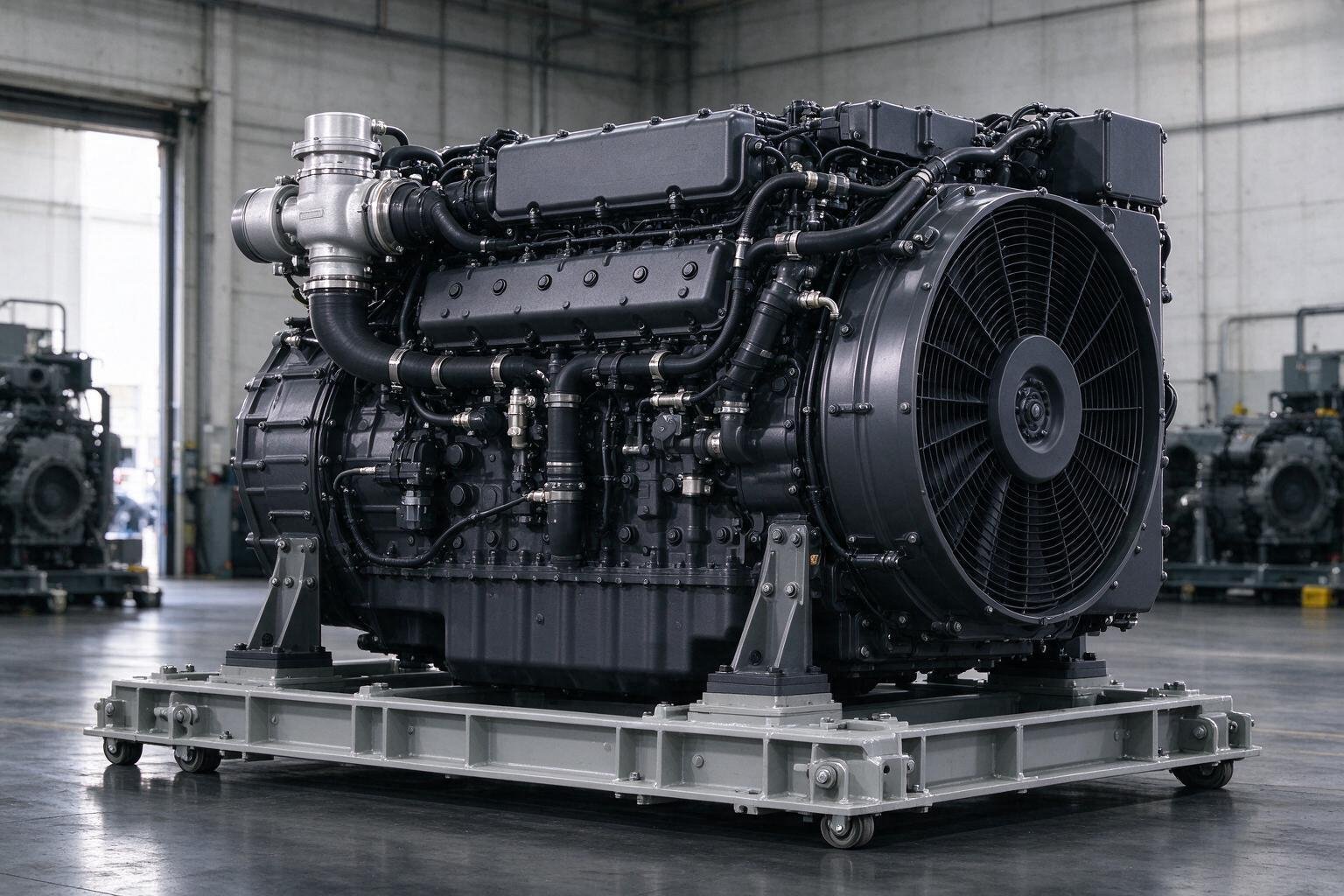
This Cummins QSK23 engine assembly buying guide covers the 23-liter diesel engine manufactured by Cummins, which is built in a 6-cylinder inline configuration and belongs to the QSK series of heavy-duty, high-output engines. The platform uses a rigid block design and is intended for continuous or high-load duty cycles rather than light automotive use.
Engine assemblies for the QSK23 are generally supplied in one of two forms. A basic long block typically includes the block, cylinder head, crankshaft, pistons, connecting rods, camshaft, and associated internal hardware, but excludes the intake, exhaust, fuel system, and cooling components. A complete drop-in unit is supplied with accessories and external components fitted, allowing a more direct replacement in the field. Buyers should confirm exactly which components are included, since long block and drop-in listings vary between suppliers.
Typical applications for the QSK23 include mining haul trucks, marine propulsion, power generation, and heavy construction equipment. Because these duty cycles place different demands on the engine, the assembly variant matters. Common designations include QSK23-C for constru
Key Specifications and Identification
The Cummins QSK23 is a 23.15 L (1,413 cu in) displacement diesel engine. Its bore and stroke are both 170 mm (6.69 in), giving a square bore-to-stroke ratio. The engine is turbocharged and aftercooled, and it uses a four-valve-per-cylinder overhead camshaft valvetrain. Fuel delivery and engine protection functions are managed by a Cummins Electronic Control Module (ECM). Calibration files are variant-specific, so the ECM program must match the engine rating, emissions configuration, and application before an assembly is placed into service.
| Specification | Value |
|---|---|
| Displacement | 23.15 L (1,413 cu in) |
| Bore x Stroke | 170 mm x 170 mm (6.69 in x 6.69 in) |
| Aspiration | Turbocharged and aftercooled |
| Valvetrain | 4 valves per cylinder, overhead camshaft |
| Engine control | Cummins ECM, variant-specific calibration |
Locating the Engine Dataplate
The engine dataplate is mounted on the cylinder block. It lists the engine model, serial number, and Critical Parts List (CPL) number. These three identifiers should be recorded before any parts are ordered or any assembly work begins.
Why the CPL Matters
The CPL defines the specific combination of components built into a given engine, including pistons, injectors, turbocharger match, and other hardware that varies across ratings and applications. Two engines sharing the same model and serial range can carry different CPLs and therefore different internal parts. Verifying the CPL against the dataplate is the reliable way to confirm component compatibility and to obtain correct replacement parts. Ordering against the model name alone risks fitting parts that do not match the build. Where the dataplate is missing or illegible, the serial number should be confirmed through official Cummins documentation before an assembly purchase proceeds.
Assessing Engine Assembly Condition
A used or remanufactured QSK23 engine assembly should be evaluated against measurable criteria rather than appearance alone. Buyers should request a detailed inspection report covering cylinder liner wear, crankshaft deflection, and camshaft lobe condition. Liner wear is typically expressed as taper, out-of-round, and maximum bore increase at the top ring reversal point; deflection figures indicate whether the block and main bore alignment remain within tolerance.
Verification of non-destructive testing is equally important. The block should have been pressure-tested and magnafluxed for cracks, with test pressure and results documented. Cavitation erosion on cylinder liners and block water passages warrants close inspection, since pitting in these areas can compromise liner life and cooling performance even when dimensions appear acceptable.
Cylinder head condition should be confirmed through records showing resurfacing and valve seat replacement where required. Deck flatness and seat concentricity are the relevant checkpoints. For the crankshaft, buyers should confirm polishing and journal measurement against OEM specifications, including main and rod journal diameters, taper, and fillet condition.
| Component | Verification Item | Documentation Requested |
|---|---|---|
| Cylinder liners | Wear, taper, cavitation pitting | Measurement report |
| Block | Pressure test, magnaflux | Test certificate |
| Crankshaft | Journal dimensions, deflection, polish | OEM spec comparison |
| Camshaft | Lobe lift and wear pattern | Inspection sheet |
| Cylinder head | Deck flatness, valve seats | Machining record |
Finally, request documentation of any previous overhauls, including parts used and machining performed. A complete history supports an informed purchase decision and helps establish expected service life.
Compatibility and Configuration Verification
A Cummins QSK23 engine assembly must be matched to its intended application before purchase. The Critical Parts List (CPL) number is the primary reference for this check. Each CPL defines a specific combination of fuel system components, governor type, and accessory drive arrangement. An assembly built for a generator set will not carry the same fuel pump settings or governor calibration as one configured for a haul truck or marine vessel. Buyers should obtain the CPL from the seller and confirm it against the intended duty.
Physical interface dimensions follow next. The flywheel housing and flywheel must match the SAE size required by the transmission or driven equipment. Common QSK23 arrangements use SAE 1 or SAE 0 housings, but the specific build determines what is fitted. Exhaust manifold orientation and turbocharger mounting position also vary by application and affect clearance in the installation envelope.
Lubrication hardware requires the same scrutiny. Oil pan sump capacity and dipstick location differ between chassis-mounted and stationary configurations, and an incorrect pan can interfere with frame rails or structural supports.
The ECM calibration must suit the target application or be reprogrammable to it. Calibration part numbers are application-specific, and some ratings are locked. Marine installations add further checks: heat exchanger size, raw water pump configuration, and coolant circuit layout must match the vessel’s cooling setup.
| Check | Reference |
|---|---|
| CPL and fuel system | CPL data sheet |
| Flywheel housing SAE size | Equipment interface drawing |
| Exhaust and turbo position | Installation drawing |
| Oil pan sump and dipstick | Assembly build list |
| ECM calibration | Calibration part number |
| Marine cooling components | Heat exchanger and pump spec |
Sourcing Options: New, Rebuilt, and Used
Cummins QSK23 engine assemblies are available through three primary channels, each with distinct cost, warranty, and risk profiles.
New Assemblies
New QSK23 assemblies are sold through authorized Cummins distributors and dealers. These units carry full factory warranty coverage and documented build records, which simplifies validation of serial numbers and parts provenance. Lead times can extend depending on distributor stock and current production allocation, so buyers should confirm availability before committing to a project schedule.
Rebuilt Assemblies
Rebuilt assemblies, often marketed as reman, are reconditioned to OEM specifications by authorized rebuilders. A proper rebuild typically includes cylinder block inspection, crankshaft regrinding or replacement, new bearings, pistons, liners, and a documented torque and clearance record. Warranty terms vary by rebuilder and may cover parts only or parts and labor; the scope should be confirmed in writing. Buyers should request the rebuild specification sheet and core acceptance criteria.
Used Assemblies
Used assemblies vary widely in condition, from low-hour takeouts to high-hour units with unknown service history. Thorough inspection is essential: check block integrity, liner wear, crankshaft end play, and evidence of overheating or contamination. Warranty terms on used units are typically limited or absent, and return policies may be short. Photographic documentation and, where feasible, a third-party inspection reduce risk.
Total Cost of Ownership
Purchase price alone is not a reliable comparison. Buyers should weigh expected service life, warranty coverage, and the downtime cost of a premature failure. A lower-priced used unit with no warranty can exceed the cost of a warranted rebuild if it fails early in service.
| Option | Warranty | Typical Risk |
|---|---|---|
| New | Full factory coverage | Low; lead time |
| Rebuilt | Varies by rebuilder | Moderate; verify spec |
| Used | Limited or none | High; inspect thoroughly |
Seller Verification
Regardless of category, buyers should verify the seller’s reputation, confirm the return policy in writing, and check references for prior QSK23 transactions.
Documentation and Warranty Considerations
Documentation is as important as the physical inspection when purchasing a Cummins QSK23 assembly. The engine serial number and Control Parts List (CPL) determine which configuration and parts catalog apply, so every document should reference both identifiers consistently.
Request the engine’s service history, including oil analysis records if available. Oil analysis trends, such as rising iron, copper, or silicon levels, can indicate wear in the cylinder liners, bearings, or intake system that a visual inspection may not reveal. Maintenance logs showing valve lash adjustments, injector service, and coolant changes help establish whether the engine received the intervals specified for the QSK23 platform.
Obtain a written warranty statement detailing coverage duration, parts and labor, and exclusions. Verify whether the warranty covers the complete assembly or only specific components, and whether it is honored nationally or limited to the seller’s location. For rebuilt engines, ask for the rebuild protocol and component replacement list, including whether the block, crankshaft, and cylinder head were machined, replaced, or reused, and which overhaul kit was applied.
Ensure the seller provides a bill of sale with engine serial number and CPL. This document supports registration, resale, and any future warranty claim. Confirm that any core charges and return policies are clearly stated in writing before payment, including the core acceptance criteria and the timeframe for returns.
| Document | Key Details to Verify |
|---|---|
| Service history | Oil analysis trends, maintenance intervals, injector and valve service |
| Warranty statement | Duration, parts and labor coverage, exclusions, service locations |
| Bill of sale | Engine serial number, CPL, date, seller identification |
| Rebuild protocol | Machining records, replaced versus reused components, overhaul kit |
| Core and return policy | Core charge amount, acceptance criteria, return window |
Installation and Commissioning Best Practices
Correct installation and commissioning determine whether a QSK23 assembly reaches its rated service life. The procedures below apply to both new and remanufactured assemblies and should be read alongside the engine-specific documentation supplied with the unit.
Mounting and Alignment
The OEM installation manual governs all mounting, alignment, and clearance requirements. These specifications take precedence over generic practice because chassis stiffness, driveline geometry, and accessory placement vary by application. Install new mounting isolators rather than reusing old ones; aged elastomer isolators lose their damping characteristics and transmit vibration into the block and driven equipment. Verify alignment between the engine output and the driven equipment using the method and tolerances stated in the manual. Incorrect alignment produces premature wear on the flywheel housing, damper, and coupling.
Fluids and Fuel System
Fill the cooling system with the coolant type specified for the QSK23, mixed to the correct concentration. Use only the engine oil grade and viscosity recommended for the ambient operating range. Prime the fuel system before the first crank and inspect all connections, filters, and lines for leaks. Air trapped in the fuel system can prevent start-up or cause uneven running during the initial minutes of operation.
Initial Run-In and Monitoring
Perform an initial run-in under light load as directed in the manual. Monitor oil pressure, coolant temperature, and exhaust gas temperature throughout. Record baseline readings so later deviations can be identified quickly.
First 50-Hour Service
After the first 50 hours of operation, change the engine oil and filters and re-torque critical fasteners to the values recommended in the service documentation. This interval removes break-in wear debris and confirms that joints have seated correctly.
Common Pitfalls in QSK23 Engine Assembly Purchasing
Several recurring mistakes can increase cost and downtime when sourcing a Cummins QSK23 engine assembly. Buyers should evaluate each of the following before committing to a purchase.
Ignoring the CPL
The Control Parts List (CPL) defines the specific configuration of an engine, including pistons, injectors, turbocharger, camshaft, and calibration. Purchasing an assembly without confirming the CPL against the intended application can result in incompatible components, incorrect fueling, and poor performance. The CPL number should be verified on the engine data plate and cross-checked against the required build.
Overlooking Flywheel Housing Size
Flywheel housing SAE size and flywheel bolt pattern vary across QSK23 configurations. A mismatch with the transmission or driven equipment bell housing will require adapters or replacement parts, causing installation delays. Housing type should be confirmed before shipment.
Skipping a Borescope Inspection on Used Engines
A used engine purchased without a borescope inspection may conceal cylinder liner scoring, piston damage, valve contact, or coolant intrusion. Visual inspection through the injector or intake ports is a low-cost step that reveals internal condition not visible externally.
Assuming All QSK23 Engines Are Identical
QSK23 assemblies are built for different applications, including mining haul trucks, generators, and industrial drives. Ratings, governing, mounting, and accessory arrangements differ. Application-specific requirements should be matched to the engine’s original build.
Neglecting Updates and Service Bulletins
Cummins issues service bulletins and part updates that affect reliability and parts supersession. An assembly built to an obsolete configuration may require rework. The serial number should be checked against current bulletin information.
Choosing a Seller Without Clear Warranty Terms
A seller without a defined warranty period or return policy leaves the buyer exposed to undisclosed defects. Written terms covering start-up, run-in, and defect remedies should be obtained before purchase.
| Pitfall | Risk | Verification Step |
|---|---|---|
| CPL not verified | Incompatible components | Check data plate CPL against application |
| Flywheel housing mismatch | Installation delay | Confirm SAE size and bolt pattern |
| No borescope inspection | Hidden internal damage | Inspect cylinders before purchase |
| Assumed identical builds | Wrong rating or mounting | Match to original application |
| No bulletin check | Reliability issues | Run serial number against updates |
| Weak warranty terms | Financial exposure | Obtain written warranty and return policy |