
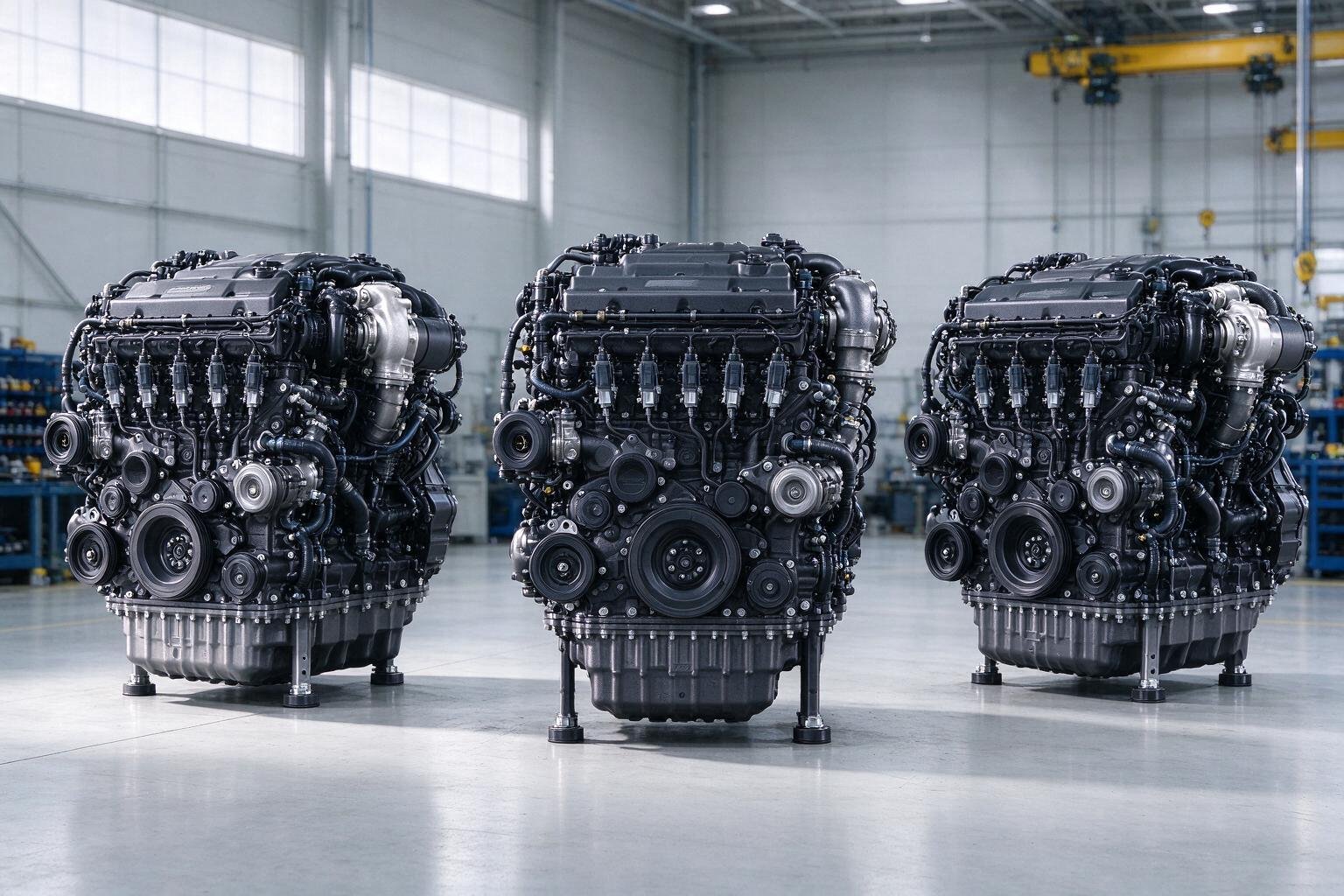
The Cummins ISX15 is a 15-liter inline-six diesel engine used in heavy-duty Class 8 trucks and vocational applications such as dump trucks, mixers, and heavy haulers. Any Cummins ISX15 engine assembly supplier comparison should begin with the two forms these assemblies are commonly offered in: a complete drop-in unit, ready for installation with accessories installed, or a long block, which covers the block, cylinder head, and internal rotating components but requires reuse or purchase of external parts. When a core engine is beyond repair, buyers typically source a replacement assembly rather than rebuild in-frame, so understanding these distinctions matters before evaluating suppliers.
Key Supplier Categories in the Market
The Cummins ISX15 aftermarket for complete engine assemblies is served by four broadly distinct supplier categories. Each differs in documentation, warranty structure, and traceability, and buyers should evaluate them against the intended duty cycle and downtime tolerance.
OEM-Authorized Dealers
Authorized Cummins dealers supply new or factory-remanufactured ISX15 assemblies. Factory remanufacturing follows published Cummins procedures, including cylinder block inspection, crankshaft regrinding or replacement, and specified torque and tolerance values. Warranty terms are documented in writing and tied to a serial number, which simplifies claims handling. Pricing is typically the highest of the four categories, and lead times depend on core availability and regional stocking.
Independent Remanufacturers
Independent rebuilders machine and reassemble used cores to their own specifications. Output quality varies considerably: two shops may both advertise a “full rebuild” while differing on whether the cylinder head is resurfaced, whether the camshaft and injectors are replaced or reused, and what bore and bearing clearances are held. Buyers should request the machining tolerances, the component replacement list, and the dynamometer test record for the specific assembly.
Salvage and Used-Parts Suppliers
Salvage yards and used-parts suppliers sell take-out assemblies removed from wrecked or retired vehicles. Service history is generally unknown, and warranty coverage ranges from a short start-up guarantee to none. These assemblies suit budget-constrained or non-critical applications where the buyer can inspect the unit, check the serial number against Cummins records, and perform a leak-down and blow-by check before installation.
Export-Focused Trading Suppliers
Trading suppliers consolidate assemblies from multiple sources for international buyers. Documentation and traceability vary widely; some provide photographs, serial numbers, and compression test data, while others supply only a shipping description. Verification of the actual engine configuration and emissions tier before shipment is advisable.
| Supplier category | Warranty | Traceability |
|---|---|---|
| OEM-authorized dealer | Documented, serial-linked | High |
| Independent remanufacturer | Varies by shop | Moderate |
| Salvage/used parts | Limited or none | Low |
| Export trading supplier | Varies widely | Variable |
Comparison Criteria for Engine Assemblies
Suppliers of Cummins ISX15 engine assemblies vary widely in documentation, rebuild practice, and warranty structure. Buyers comparing quotes should evaluate each offer against the same set of technical criteria rather than price alone.
Traceability
Every assembly should carry a documented engine serial number (ESN) and parts list (CPL) configuration. Core origin should also be recorded, including the donor engine’s ESN and its prior service history where available. Assemblies without this data are difficult to verify against the intended application and complicate later warranty claims.
Rebuild Specification
Confirm the machining operations performed on the block and head. Line-boring of the main journals and resurfacing of the cylinder head are baseline operations for a quality rebuild. The crankshaft status should be stated explicitly: new, reground to a specific undersize, or reused as-is. Reground crankshafts should be supplied with journal dimensions and hardness test results.
Component Policy
Suppliers should identify the status of major components, including injectors, turbocharger, oil pump, and water pump. Each item should be listed as new, remanufactured, or reused. Mixed policies are common, but the mix should be disclosed in writing.
Warranty Terms
Compare duration, mileage limits, labor coverage, and the claim procedure. Some suppliers cover parts only; others include labor allowances with defined caps. Claim filing deadlines and required documentation, such as installation records and fault codes, should be confirmed before purchase.
Test Documentation
Dyno test sheets showing break-in load, oil pressure at operating temperature, and any fault codes logged during the run support quality claims. Suppliers who cannot provide test records for a given assembly should be evaluated accordingly.
| Criterion | What to Request |
|---|---|
| Traceability | ESN, CPL, core origin |
| Rebuild spec | Line-bore and resurface records, crankshaft status |
| Component policy | New/reman/reused list by part |
| Warranty | Duration, mileage, labor, claim process |
| Testing | Dyno sheet, oil pressure log |
Verifying Part Numbers and Fitment
Fitment verification for a Cummins ISX15 engine assembly begins with the engine serial number (ESN). The ESN should be cross-referenced against Cummins parts catalogs to confirm the correct assembly part number and the associated Critical Parts List (CPL) configuration. The CPL defines the specific component set built into that engine, including injectors, turbocharger, pistons, and electronic calibration. Two assemblies that share a common block casting can still differ at the CPL level, so a quoted part number without a matching CPL should be treated as incomplete.
Emissions hardware is a frequent source of mismatch. An EPA 2007 ISX15 assembly will not directly substitute for an EPA 2010 unit without supporting changes to the aftertreatment system, ECM calibration, and related sensors and harnesses. Buyers should confirm the emissions certification year of the donor or rebuilt unit against the intended application before committing to a purchase.
Physical interface checks are equally important. Confirm the transmission interface and bell housing pattern, the accessory drive configuration (front gear train layout, fan hub, and pulley arrangement), and the mounting points match the original engine. These details vary by application and are not always captured by the assembly part number alone.
Request photographs of the ESN plate and the major casting numbers before ordering. Comparing these images against the quoted specification confirms the unit is the one described in the quote and reduces the risk of receiving a functionally different assembly.
| Verification Item | What to Confirm |
|---|---|
| ESN and CPL | Assembly part number matches catalog entry for that ESN |
| Emissions year | EPA 2007 vs. EPA 2010 hardware and calibration |
| Transmission interface | Bell housing pattern and flywheel housing |
| Accessory drive | Front gear train, fan hub, pulley layout |
| Documentation | Photos of ESN plate and casting numbers |
New, Remanufactured, and Used Assemblies
Buyers comparing Cummins ISX15 engine assemblies encounter four distinct supply categories, each with different cost, warranty, and availability profiles.
New assemblies carry the highest purchase price and the clearest warranty coverage, typically backed directly by the manufacturer. Availability is the constraint: certain older ISX15 configurations and emissions variants are no longer in active production, and lead times for remaining part numbers can extend significantly. New units suit applications where downtime cost outweighs acquisition cost and where the exact configuration remains orderable.
Factory remanufactured units are rebuilt to OEM specifications, with defined inspection, machining, and replacement criteria for major components. They typically include a standardized warranty that approaches new-unit terms. Supply is generally broader than new, though popular part numbers can still see allocation pressure.
Independent remanufactured assemblies vary widely in specification. Some rebuilders follow documented protocols with published tolerances; others perform more limited refresh work. Buyers should request the rebuild protocol in writing, including cylinder head work, liner and piston replacement criteria, bearing specification, and dynamometer test results, and compare those documents across suppliers before pricing decisions.
Used take-out assemblies serve budget-constrained or short-term applications, such as equipment nearing end of service life or a temporary repair. Service-history risk is inherent: mileage, duty cycle, and prior overheating or contamination events are often undocumented. A compression test, oil analysis, and visual inspection of the block and head are minimum checks.
| Category | Relative Cost | Warranty | Availability | Primary Risk |
|---|---|---|---|---|
| New | Highest | Clearest, manufacturer-backed | Limited for older configurations | Lead time |
| Factory remanufactured | Moderate to high | Standardized, near-new terms | Broad | Core charges |
| Independent remanufactured | Moderate | Varies by builder | Broad | Undocumented specification |
| Used take-out | Lowest | Minimal or none | Immediate | Unknown service history |
Documentation and Compliance Checks
Documentation separates a verifiable Cummins ISX15 assembly quote from an incomplete one. Buyers should request the bill of materials, rebuild report, and test records with each quote, not after the order is placed. The bill of materials should list part numbers for major components, including the cylinder head, crankshaft, pistons, liners, and turbocharger, so the buyer can confirm the build matches the intended configuration. The rebuild report should state whether the block and head were machined, what oversize or undersize values were applied, and which components were replaced versus reused. Test records should cover oil pressure, compression, and any dynamometer run-in data the supplier performs.
For cross-border purchases, export documentation and HS codes need confirmation before shipment. The buyer should verify the HS code applied to the engine assembly and confirm the supplier provides a commercial invoice, packing list, and certificate of origin where applicable. Emissions compliance is a separate matter: the destination market may regulate the engine based on its original tier or application, and the buyer is responsible for confirming that the assembly is acceptable for the intended use.
Warranty terms warrant the same scrutiny. Buyers should verify whether coverage transfers with the assembly and whether the supplier honors claims in the buyer’s country, including who performs labor and how parts are supplied. A warranty limited to the supplier’s domestic market offers little practical value.
Finally, confirm that the supplier can provide core return instructions and credit terms in writing. Core acceptance criteria, return shipping responsibility, and the credit amount should be defined before purchase, since core charges can materially affect the total cost.
| Document | Purpose | Confirm before order |
|---|---|---|
| Bill of materials | Component traceability | Part numbers and configuration |
| Rebuild report | Machining and replacement record | Oversize values, reused parts |
| Test records | Performance verification | Oil pressure, compression, dyno data |
| Export documents | Customs clearance | HS code, invoice, origin certificate |
| Warranty terms | Claim coverage | Transferability, in-country service |
| Core return terms | Credit recovery | Acceptance criteria, shipping, credit amount |
Inspection on Receipt
Every Cummins ISX15 engine assembly received from an external supplier should pass a documented inspection before it enters inventory or moves to the installation bay. The inspection is the buyer’s only opportunity to establish a condition baseline and to support a claim if a defect is later traced to shipping or supplier handling.
Identification and documentation
The first step is to record the engine serial number (ESN) from the data plate and compare it against the purchase order, packing list, and supplier invoice. The ESN confirms the correct configuration was shipped, including the emissions family and rating. Any mismatch should be resolved in writing with the supplier before the unit is accepted. Photograph the plate and note the date and time of receipt.
Visual inspection of major castings
Inspect the cylinder block, cylinder head, and oil pan for cracks, corrosion, and evidence of prior repair. Look for weld beads, heli-coils, thread inserts, or grinding marks that suggest rework. Check machined surfaces for rust pitting, and confirm that all shipping plugs and covers remain in place. Corrosion on the block deck or liner bores is a common indicator of prolonged or improper storage.
Fluid residue check
Check the exterior and the shipping skid for oil and coolant residue. Fresh fluid usually indicates a leak at a plug, fitting, or gasket. Residual coolant in the water pump inlet or oil in the pan drain area can also mean the assembly was not fully drained before shipment, which risks contamination and freeze damage in cold conditions.
Crankshaft rotation
Where the assembly permits, rotate the crankshaft by hand using the front pulley bolt or damper. Movement should be smooth and free through at least two full revolutions, with no binding, scraping, or interference. Any resistance should be investigated and documented before installation begins.
| Check | Acceptable condition | Action if failed |
|---|---|---|
| ESN match | Matches documentation | Hold; contact supplier |
| Castings | No cracks or rework | Photograph; file claim |
| Fluid residue | Dry exterior | Inspect seals and plugs |
| Rotation | Free, no binding | Do not install |
Summary Comparison Approach
A structured comparison of Cummins ISX15 engine assembly suppliers should begin with a shortlist of three to five vendors. Each supplier is then scored against five criteria: traceability, rebuild specification, warranty, documentation, and price. Traceability covers whether the supplier can document the block, head, crankshaft, and other major components back to source, including serial numbers and core history. Rebuild specification addresses whether the assembly follows OEM tolerances, which components are new versus remanufactured, and whether the supplier publishes its build sheet. Warranty terms should be compared on duration, coverage scope, and claims process. Documentation includes build records, torque specifications, and test data supplied with the unit.
Requesting identical quote templates from every supplier is the most reliable way to enable direct comparison. A standardized template forces each vendor to quote the same configuration, core charges, and freight basis, which prevents line-item mismatches from distorting the price picture.
Weighting depends on the application. For long-term fleet use, warranty and documentation should carry more weight, since downtime and resale value depend on a defensible paper trail. For short-term or resale use, price can carry more weight, provided traceability remains adequate.
| Criterion | Fleet (long-term) | Resale (short-term) |
|---|---|---|
| Traceability | High | Medium |
| Rebuild specification | High | Medium |
| Warranty | High | Medium |
| Documentation | High | Low |
| Price | Medium | High |
Lead times and shipping terms should be confirmed before any commitment. A complete ISX15 assembly is heavy and bulky, so freight cost and transit time represent a significant share of total landed cost and can vary substantially between suppliers.