
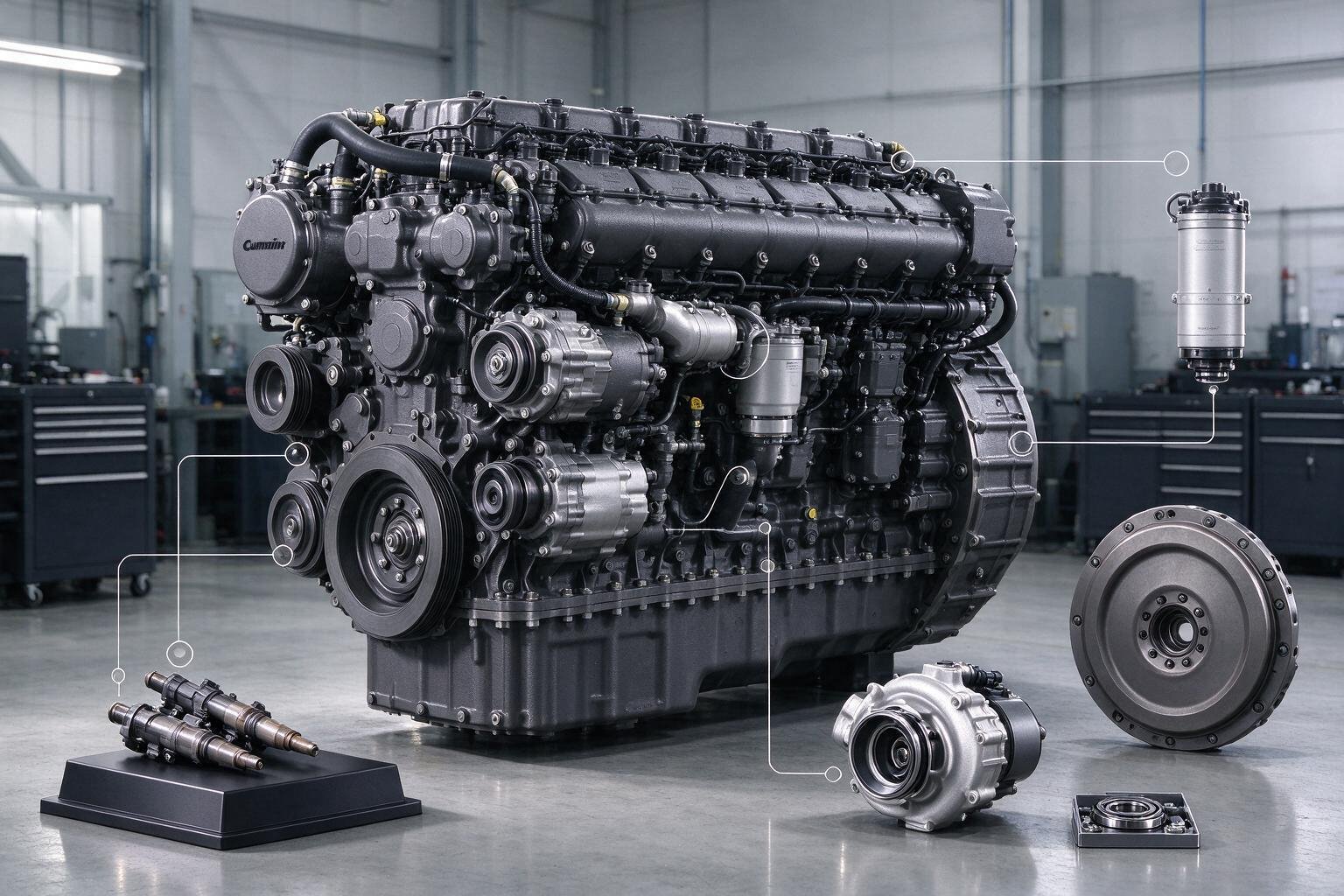
Understanding the Cummins QSK19 Engine
The Cummins QSK19 is a 19-liter, six-cylinder diesel engine built for continuous and heavy-duty service. Its displacement and torque characteristics suit applications where sustained load matters more than peak speed, which is why it appears across mining haul trucks and excavators, construction equipment, marine propulsion and auxiliary sets, and stationary power generation. The same base architecture serves all of these markets, but the accessory and mounting configurations differ substantially between them.
The engine uses a quad turbocharger arrangement—four turbochargers in a staged configuration—combined with air-to-air aftercooling to manage intake charge density and thermal load. Power ratings span roughly 450 to 800 hp depending on calibration, fuel system settings, and the duty cycle the engine is rated for. A generator-drive unit and a haul truck unit of the same displacement may carry different pistons, injectors, and turbocharger part numbers.
For parts selection, the QSK19 is best approached as a set of major assemblies rather than a single parts list:
- Cylinder head and valvetrain components
- Cylinder block and liners
- Crankshaft, bearings, and connecting rods
- Pistons and rings
- Turbochargers and associated plumbing
- Fuel system, including injectors and pumps
- Electronic control and sensor hardware
Configurations vary by rating and application, so the engine serial number and the original rating plate are the reliable starting points for identifying correct parts. A part that fits a 450 hp marine configuration may not be interchangeable with an 800 hp mining configuration, even where the assembly looks similar externally. Buyers should confirm the application, rating, and serial number break before ordering any major component.
Importance of Engine Serial Number (ESN)
The Engine Serial Number (ESN) is the primary reference for identifying the correct parts for any Cummins QSK19 engine. Each ESN is a unique identifier assigned to a specific engine build, and it determines the exact parts list that applies to that unit. Two QSK19 engines of the same rating and application can carry different components depending on build date and configuration, so the ESN is the only reliable way to confirm which parts are correct.
Cummins uses the ESN to track engineering changes and part supersessions across the production life of the engine. When a component is revised, the change is recorded against a defined ESN range. A part that fits an early QSK19 may be superseded by a different part number on a later build, and the ESN range is what defines the break point. Ordering by engine model alone does not capture these distinctions.
For this reason, the ESN should always be obtained before any parts order is placed. Ordering without it risks mismatches between the part supplied and the part the engine was built with, which can result in fitment problems, incorrect clearances, or repeat labor. The ESN also allows a parts supplier or dealer to cross-reference superseded numbers and confirm the current replacement part.
The ESN is typically stamped on the engine dataplate and also on the engine block. The dataplate is the first location to check, and the block stamping serves as a secondary reference if the plate is missing or unreadable. Both locations should be recorded and compared before parts are ordered.
| Location | Purpose |
|---|---|
| Engine dataplate | Primary ESN reference, along with model and rating |
| Engine block stamping | Secondary confirmation if the dataplate is damaged or missing |
Recording the full ESN, not a partial number, is necessary for accurate parts lookup.
Common Parts Categories and Their Functions
The QSK19 is a 19-liter, inline six-cylinder diesel engine used in mining haul trucks, locomotives, marine vessels, and power generation. Parts fall into several functional groups, each with distinct wear characteristics and replacement intervals.
Cylinder Head Components
Valves, valve springs, valve guides, and head gaskets seal the combustion chamber and maintain compression. Intake and exhaust valves must seat precisely against their seats; worn guides allow valve stem movement that degrades seating and oil control. Head gaskets must withstand high cylinder pressure and coolant flow between block and head. These parts directly affect compression ratio, combustion quality, and oil consumption.
Fuel System
Injectors, the fuel pump, and fuel filters govern injection timing, fuel quantity, and atomization. Contaminated fuel or worn injector nozzles produce poor spray patterns, incomplete combustion, and elevated emissions. Filter quality and change intervals matter on this platform because injector and pump clearances are tight.
Turbochargers
The QSK19 uses two-stage turbocharging, with a low-pressure and a high-pressure stage in series. Serviceable parts include cartridges (center housings with bearings and wheels), compressor and turbine housings, and wastegates. Bearing wear, oil contamination, and exhaust-side fouling are the usual failure causes. Stage matching matters: replacing one stage without assessing the other can affect boost pressure and exhaust temperature.
Cooling System
The water pump, thermostat, and radiator components hold operating temperature within specification. Coolant condition and thermostat function affect both overheating risk and liner cavitation protection.
Electrical
Sensors (coolant temperature, oil pressure, intake manifold pressure), the ECM, and wiring harnesses support engine control and diagnostics. Connector corrosion and harness chafing are common faults on high-vibration applications.
| Category | Key Parts | Primary Function |
|---|---|---|
| Cylinder head | Valves, springs, guides, gaskets | Compression and combustion sealing |
| Fuel system | Injectors, pump, filters | Injection timing and emissions control |
| Turbocharging | Cartridges, housings, wastegates | Two-stage boost pressure |
| Cooling | Water pump, thermostat, radiator parts | Operating temperature control |
| Electrical | Sensors, ECM, harnesses | Engine control and diagnostics |
Genuine vs. Aftermarket Parts
The choice between genuine Cummins parts and aftermarket alternatives affects fit, reliability, and long-term operating cost on the QSK19. Genuine parts are produced to the original specification and guarantee exact fit and consistent reliability, but they carry a higher purchase price. Aftermarket parts can be cost-effective when sourced from reputable manufacturers, though quality varies widely across the market. Buyers should assess warranty terms, material quality, and supplier reputation before committing to a non-genuine component.
| Factor | Genuine Cummins | Aftermarket |
|---|---|---|
| Fit and tolerance | Exact to original specification | Varies by manufacturer |
| Purchase price | Higher | Generally lower |
| Warranty | Backed by Cummins | Depends on supplier |
| Material quality | Controlled and documented | Inconsistent across brands |
| Emissions compliance | Maintained | Not always verified |
For critical components such as injectors and turbochargers, genuine parts are recommended. These assemblies directly influence fuel delivery, boost pressure, and combustion characteristics, and deviations from specification can reduce performance and compromise emissions compliance. A low-cost injector or turbocharger that fails to match original flow and tolerance data may cost more over its service life than the genuine unit it replaced.
Aftermarket parts remain a reasonable option for certain non-critical items, provided the buyer verifies the manufacturer’s reputation, reviews warranty coverage, and confirms that material specifications meet or exceed the original. Documentation of the part’s origin and any applicable certifications supports informed purchasing decisions. In every case, matching the part number to the engine serial number and build configuration reduces the risk of incorrect fitment.
Evaluating Parts Quality
Quality assessment for Cummins QSK19 components should begin with documentation. Suppliers of engine parts for the QSK19, a 19-liter inline-six used in mining, marine, and power generation applications, should be able to provide certificates demonstrating compliance with recognized quality management standards. ISO/TS 16949 (now superseded by IATF 16949) is the relevant benchmark for automotive quality management systems, and certification indicates that a supplier’s production processes are subject to third-party audit. Buyers should verify certificate scope and validity rather than accept a logo at face value.
Material specification is the second checkpoint. Pistons for the QSK19 should be forged aluminum, which offers higher fatigue strength and thermal resistance than cast alternatives under the high cylinder pressures typical of this engine. Connecting rods, cylinder liners, and crankshafts should match the original material grades and heat-treatment requirements. Suppliers should state material specifications in writing.
Evidence of reverse engineering warrants close inspection. Poor surface finish on machined faces, inconsistent dimensions across a sample batch, or missing part markings and casting numbers are indicators that a component was copied rather than produced to specification. Dimensional reports from a coordinate measuring machine provide objective confirmation.
Finally, buyers should request test reports covering hardness, dimensional tolerance, and where applicable, fatigue or pressure testing. A written warranty with defined terms and duration is a further indicator of supplier confidence. Parts offered without documentation or warranty carry elevated risk, particularly for internal engine components where failure can cause secondary damage.
| Check | Acceptable Evidence |
|---|---|
| Quality certification | Valid IATF 16949 or ISO/TS 16949 certificate with scope |
| Material grade | Written specification, forged aluminum pistons |
| Manufacturing consistency | CMM dimensional report, consistent markings |
| Testing and warranty | Hardness and dimensional test reports, written warranty |
Sourcing and Supplier Vetting
Supplier selection for Cummins QSK19 components carries direct consequences for engine reliability, warranty standing, and downtime cost. A structured vetting process reduces exposure to substandard or misrepresented parts.
Credential verification
Buyers should request the supplier’s business license and confirm that the registered entity matches the trading name and bank details on the quotation. Years in business is a useful indicator but should be corroborated through customer references, particularly from operators in mining, marine, or power generation applications where QSK19 engines see heavy duty. References from buyers of comparable volume and part categories are more meaningful than generic testimonials.
Traceability
A credible supplier can state the origin of each part and provide batch or lot numbers that link the component to a production run. For genuine Cummins parts, packaging labels, part numbers, and date codes should be consistent with Cummins documentation. Suppliers unable to explain where stock was sourced, or who offer only vague assurances, present elevated risk.
Counterfeit risk
Cummins parts, including injectors, turbochargers, and fuel system components, are frequently counterfeited. Visual comparison against known-genuine samples, scrutiny of packaging print quality, and price checks against market norms are practical first filters. Where possible, purchasing through authorized distributors removes most of this risk, though lead times and pricing may differ.
Logistics evaluation
Lead time commitments should be confirmed in writing, with clarity on stock status versus backorder. Shipping method affects both transit time and handling risk; sea freight suits bulk orders, while air freight is common for urgent single components. Packaging quality deserves inspection on receipt: genuine Cummins parts typically arrive in robust, clearly labeled cartons, and poor packaging often signals a non-genuine supply chain.
| Check | What to request |
|---|---|
| Credentials | Business license, years active, references |
| Traceability | Part origin, batch/lot numbers |
| Counterfeit controls | Authorized channel status, packaging review |
| Logistics | Written lead times, shipping method, packaging standards |
Maintenance and Replacement Intervals
The Cummins QSK19 is a heavy-duty, 19-liter engine used in mining haul trucks, locomotives, marine propulsion, and power generation. Maintenance intervals should follow the Cummins published schedule for the specific application and duty cycle rather than a single universal timetable, since load factor, fuel quality, ambient conditions, and operating hours all affect wear rates. Engines run at high continuous load, such as in generator sets, generally require closer attention to oil condition than those in intermittent duty.
As a baseline, many QSK19 applications call for oil and filter changes at approximately 500-hour intervals, with the exact figure confirmed against the engine-specific service manual and oil analysis results. Valve lash adjustment is typically scheduled around 2,000 hours; incorrect lash affects compression, emissions, and injector performance. Injectors are replaced on condition rather than a fixed interval, based on misfire codes, fuel delivery tests, and exhaust readings.
| Service Item | Typical Interval | Notes |
|---|---|---|
| Oil and filter change | 500 hours | Confirm against duty cycle and oil analysis |
| Valve lash adjustment | 2,000 hours | Verify torque and clearances per manual |
| Injector replacement | As needed | Condition-based, guided by diagnostics |
Keeping records of every parts replacement allows operators to track component life against hours and load, which helps anticipate failures and plan downtime. Condition monitoring supports this effort: oil analysis identifies coolant contamination, fuel dilution, and elevated wear metals, while vibration analysis can flag bearing or drivetrain issues before they escalate. Acting on these signals allows components to run closer to their true service limit, extending life without compromising reliability.
Cost Considerations and Budgeting
A Cummins QSK19 major overhaul can consume a substantial share of the engine’s current market value, particularly on higher-hour units. Budgeting should therefore be based on lifecycle cost rather than purchase price alone. A practical approach is to estimate hours to the next overhaul, allocate the expected parts and labor cost across that interval, and treat it as a per-hour operating expense. This makes it easier to compare rebuild versus replacement decisions and to set aside reserves before a failure forces unplanned spending.
Remanufactured parts occupy a useful middle ground between new and used components. Remanufactured cylinder heads, injectors, and rotating assemblies typically carry documented inspection and testing and a defined warranty, at a lower cost than new. Used parts may be cheaper still but carry uncertain service history, which matters on a high-output engine such as the QSK19. Buyers should confirm core charges and return freight, since these can narrow the apparent gap between new and remanufactured pricing.
Downtime is often the largest hidden cost. A generator set or haul truck out of service accrues lost revenue or rental replacement expense daily. Faster parts availability from a regional stocking supplier can justify a higher unit price when it shortens the repair window by several days.
| Cost Element | Budgeting Note |
|---|---|
| Major overhaul parts | Significant share of engine value; reserve over lifecycle |
| Remanufactured vs. new | Lower cost with documented testing and warranty |
| Downtime | Often exceeds parts cost; weigh against availability |
| Bulk and long-term supply | Negotiate volume pricing and lead-time commitments |
Bulk orders for consumables and planned overhaul kits, together with long-term supplier agreements, provide leverage for pricing and priority allocation during shortages.