
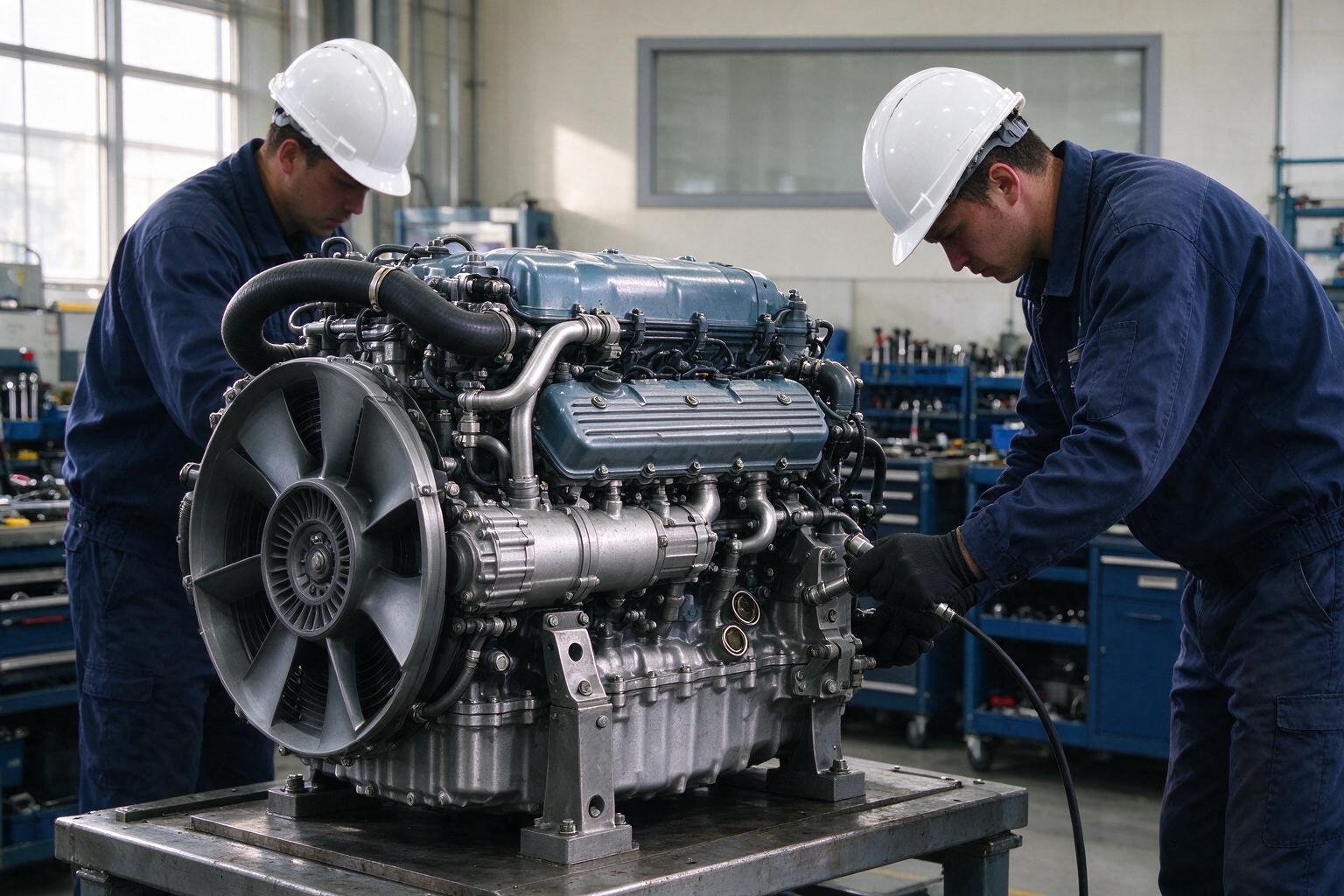
CPL stands for Critical Parts List, and in Cummins terminology it is a control number that identifies one specific build configuration of an engine family. Cummins CPL code engine assembly matching works by assigning every engine that leaves the line a CPL describing the exact combination of components installed on that unit. The same base engine model can carry many different CPL numbers. An ISB 6.7 or a QSX15 is a platform designation, not a single parts specification. Within one platform, differences in injectors, turbochargers, pistons, camshafts, governors, and emissions hardware produce distinct configurations, and each configuration receives its own CPL. Two engines with the same model name may share almost no service parts if their CPL numbers differ.
CPL Versus Engine Serial Number and Model
Three identifiers are commonly used when specifying parts for a Cummins engine, and each carries a different scope of meaning.
The engine model describes the family and displacement, such as ISB 6.7 or X15. It identifies the general architecture of the engine but does not define the exact parts content. Two engines of the same model can carry different pistons, injectors, turbochargers, or gasket sets depending on the build specification.
The engine serial number (ESN) is unique to one engine. It is the primary key for warranty and service records, and it ties the individual engine to its original build data. Because the ESN is unique, it is the most precise identifier available for parts lookup.
The CPL (Control Parts List) describes the parts configuration shared by a group of engines built to the same specification. A single CPL can cover many engines, and a single engine model can span many CPLs over its production life.
In practice, parts lookup generally starts with the ESN, which resolves to the CPL, and then to the specific part numbers for that configuration.
| Identifier | Scope | Primary use |
|---|---|---|
| Engine model | Family and displacement | General categorization |
| Engine serial number (ESN) | One individual engine | Warranty, service records, exact build |
| CPL | Group of engines built to one specification | Parts configuration reference |
Quoting a CPL alone can be insufficient where mid-production changes occurred. In those cases, the ESN confirms the exact build and avoids supplying a part that fits the CPL in general but not the specific engine in question.
Where to Find the CPL Code
The engine dataplate is the primary source for the CPL (Critical Parts List) code. Cummins typically mounts this plate on the cylinder block or in the rocker housing area, with the exact location varying by engine family. On B-series engines, for example, the plate is commonly found on the right side of the block near the oil cooler, while larger displacement engines may carry it on the rocker housing or front gear housing.
Dataplate fields usually include the engine model, engine serial number (ESN), CPL, and advertised power rating. The CPL is the four-digit number that defines the specific parts combination used to build that engine. Because a single engine model can be produced in many CPL configurations, the CPL—not the model alone—determines which pistons, injectors, turbocharger, and other components are correct for a given assembly.
The CPL may also appear on the valve cover label on some engines and in the OEM machine documentation, such as the equipment build sheet or service manual supplement. For remanufactured or replacement assemblies, the CPL is stamped or recorded on the assembly documentation rather than on a new dataplate, so the paperwork accompanying the assembly should be retained.
If the dataplate is missing or unreadable, the ESN can be used to request the CPL from a Cummins distributor. The ESN is often stamped directly into the block in addition to appearing on the plate, which allows identification even when the plate has been damaged or removed.
Why the CPL Matters When Matching an Assembly
A Cummins Critical Parts List (CPL) number defines the exact configuration of an engine build, including the specific combination of components and calibration used for that rating and application. When replacing an engine assembly, the replacement must match the CPL of the original unit, or the surrounding systems must be updated to suit the new configuration. Treating the CPL as a formality risks mismatches that are not visible at the point of installation.
Injectors, turbochargers, ECM calibration, and aftertreatment components are all calibrated to the CPL. These parts are not interchangeable across configurations without consequence. Mixing components from different CPLs can produce fueling errors, set fault codes, and in emissions-regulated applications, result in non-compliance.
The ECM calibration file is tied to both the CPL and the power rating. An assembly carrying a different CPL may require a calibration change before it will run correctly in the application. Calibration is not a standalone value; it is matched to the hardware set defined by the CPL.
Physical differences also exist between CPLs of the same engine model. Accessory drives, flywheel housings, and oil pan configurations can vary, so two assemblies that share a model designation may not be drop-in equivalents.
| Consideration | Effect of CPL mismatch |
|---|---|
| Injectors and turbocharger | Fueling and boost errors |
| ECM calibration | Incorrect file for CPL and rating |
| Aftertreatment | Emissions non-compliance |
| Accessory drives, flywheel housing, oil pan | Physical fitment differences |
Matching by CPL avoids the common failure of fitting a part that physically installs but is calibrated for a different build.
Step-by-Step Matching Procedure
The following sequence applies when matching a replacement engine assembly to a Cummins unit using the Critical Parts List (CPL) code.
1. Record the identification data
Locate the engine dataplate and record the Engine Serial Number (ESN) and the four-digit CPL code. Photograph the plate so the characters remain legible for later reference, particularly where the stamping is worn or painted over.
2. Confirm the engine model and displacement
Cross-check the ESN against the engine model and displacement (for example, B-series 5.9 L or X15 15.0 L). This step narrows the parts family before any CPL lookup begins.
3. Resolve the CPL to part numbers
Use Cummins parts literature or an authorized distributor to translate the CPL into the specific part numbers for the components in question. The CPL defines the exact configuration built at the plant, including fuel system, turbocharger, and electronic calibration.
4. Compare the candidate assembly
Compare the candidate assembly’s CPL against the original. A direct match requires no calibration change and is the preferred outcome.
5. Assess differences where the CPL does not match
Where the CPL differs, list the affected systems before proceeding:
| System | Check |
|---|---|
| Fuel system | Injector and pump part numbers |
| Air handling | Turbocharger and manifold configuration |
| ECM calibration | Calibration code and rating |
| Aftertreatment | DOC/DPF/SCR configuration |
| Accessory drive | Pulleys, brackets, and mounting |
6. Verify rating and emissions certification
Confirm the replacement assembly’s power rating and emissions certification suit the application and the jurisdiction in which the engine operates.
7. Document the change
Record the CPL change in the service record so future parts orders reference the correct configuration.
Common Pitfalls in CPL Matching
CPL matching errors are a frequent cause of incorrect parts orders on Cummins engines. The CPL (Critical Parts List) defines the exact configuration of an engine as built, and several recurring mistakes undermine accurate identification.
Assuming model-wide parts commonality
A common error is treating every engine of a given model as mechanically identical. In practice, a single model such as the ISX15 or QSB6.7 can carry dozens of distinct CPLs, each with different pistons, injectors, turbochargers, or gasket sets. CPL variation is the norm, not the exception. Parts selected by model name alone frequently do not fit.
Using a CPL from a similar machine
When the dataplate is inaccessible, there is a tendency to borrow a CPL from a similar machine in the same fleet or application. This substitutes an assumed configuration for the engine’s actual recorded data. The CPL must come from the engine’s own dataplate or an official serial-number lookup, not from a sibling unit.
Overlooking mid-year CPL revisions
During a production year, a CPL may be revised and a superseded part number replaced by a newer one. Ordering against the original CPL without checking for a revision can yield a part that no longer matches the current build or service replacement.
Treating rebuilt assemblies as identical
A rebuilt or remanufactured assembly may carry a different recorded CPL than the original engine, particularly where the rebuilder substituted updated components. Confirming the CPL associated with the rebuilt unit prevents mismatches.
Ignoring emissions tier differences
The same engine model can appear under different CPLs with distinct emissions tiers. Aftertreatment, injection, and calibration parts are not interchangeable across tiers, so the CPL must be read alongside the emissions certification.
| Pitfall | Correct approach |
|---|---|
| Model-based parts selection | Match by CPL |
| CPL from similar machine | Use engine dataplate |
| Ignoring revisions | Check superseded numbers |
| Assuming rebuilt equals original | Verify recorded CPL |
| Overlooking emissions tier | Confirm tier with CPL |
CPL, Remanufactured Assemblies, and Parts Supersession
A remanufactured Cummins assembly carries a CPL or configuration reference that should be checked against the original engine before installation. Remanufacturers build to a specific configuration, and the CPL on the assembly tag or documentation identifies which build that is. An assembly built to a different CPL may physically fit but carry different pistons, injectors, camshaft, or calibration-relevant hardware.
Cummins parts supersession adds a second layer. A supersession replaces an original part number with an updated one, often because of a design revision or a consolidated service part. The CPL remains the governing configuration reference; the superseded number describes the part, while the CPL describes the engine build the part must serve. A superseded part is generally backward-compatible within the same CPL, since the update was released to service that configuration. Cross-CPL substitution is different: a part superseded into or out of another CPL requires verification against the engine’s actual build, because the update may have been released for a different combination of components.
| Document | Purpose |
|---|---|
| CPL | Identifies the engine configuration the assembly or part must match |
| ESN | Ties the engine to its factory build record, where available |
| Calibration documentation | Confirms the ECM calibration is appropriate for the configuration |
| Supersession record | Shows the original-to-updated part number chain |
Buyers sourcing used or remanufactured assemblies should request the CPL, the ESN if available, and any calibration documentation. These items allow the buyer to confirm the assembly matches the target engine rather than relying on the part number alone.
Summary
The CPL code is the configuration key that links a Cummins engine to its exact parts content. Each Critical Parts List number identifies a specific combination of components — pistons, injectors, turbocharger, fuel system hardware, and related assemblies — as built for a given rating and emissions configuration. Two engines of the same model and displacement can carry different CPLs and therefore different parts content. Treating the model designation alone as sufficient for parts selection is a common source of fitment error.
Correct assembly matching starts with the dataplate. The plate carries the engine serial number (ESN) and the CPL, and both should be confirmed against the engine documentation before any part is ordered. The ESN establishes build date and production changes; the CPL establishes the parts configuration. Calibration and emissions implications should also be checked at this stage, since a CPL change can correspond to a different power rating, fuel calibration, or aftertreatment strategy.
Where the CPL differs from the one recorded for the engine, the affected systems must be identified and updated rather than assumed compatible. A replacement assembly from a different CPL may physically install but deliver incorrect fueling, altered emissions output, or mismatched sensor and harness interfaces. The systems affected by the CPL difference should be listed and each part verified against the correct configuration.
Recording the CPL with every parts order reduces mismatch risk over the life of the engine. A parts history tied to the ESN and CPL gives later maintenance a reliable reference and prevents a substituted component from being carried forward as if it were original content.