
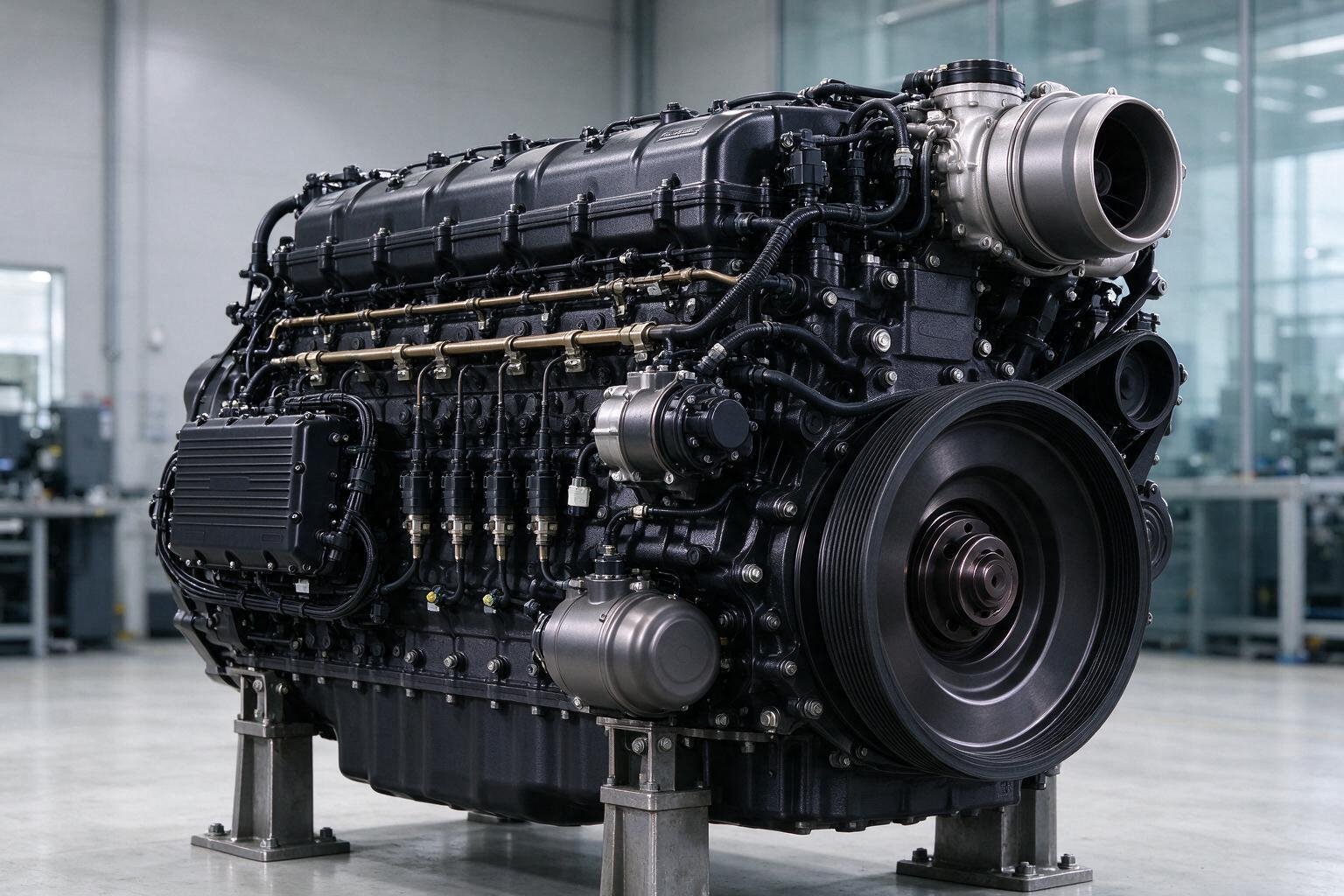
The Cummins QSK19 engine assembly price depends on rating, configuration, and what the assembly includes, so buyers should compare quotes on a like-for-like basis. The QSK19 is a 19-liter, inline six-cylinder diesel engine manufactured by Cummins, used in mining haul trucks, locomotives, marine propulsion, and heavy power generation. Its torque characteristics and cooling capacity suit continuous-duty applications where downtime carries significant cost.
An engine assembly, also called a complete engine or drop-in engine, typically includes the block, cylinder head, crankshaft, pistons, camshaft, and internal components. It usually excludes accessories such as the radiator, starter, alternator, and ECM unless the listing specifies otherwise. Buyers should verify what is included, because a quote for a bare long block and a quote for a dressed assembly are not directly comparable.
Because the QSK19 serves multiple applications, assemblies are built to different ratings and configurations. Horsepower rating, fuel system, governor type, and emissions tier all vary by application, and each variation affects price. A marine propulsion rating and a mining haul truck rating may share the same displacement but differ in injectors, turbocharger, and calibration.
Before comparing quo
New, Remanufactured, and Rebuilt: How Condition Affects Price
Condition is the single largest price variable for a Cummins QSK19 engine assembly. The four common supply categories differ in cost, warranty coverage, and risk.
New OEM assemblies carry the highest price. They typically include a full factory warranty and documented build records. Availability can be limited for older rating configurations, since certain ratings are no longer in active production. Lead times should be confirmed before budgeting.
Factory remanufactured assemblies are rebuilt to OEM specification, with defined replacement of wear components such as bearings, pistons, liners, and the oil and water pumps. A core exchange is normally required. Pricing sits below new but above most rebuilt options, and the warranty is generally more comprehensive than that of a rebuilt unit.
Rebuilt or reconditioned assemblies vary widely. Price depends on which components were replaced, whether the block and crankshaft were machined, and what testing was performed. A rebuild with a line-bored block, ground crankshaft, and dynamometer verification costs more than one with only gaskets and bearings replaced.
Used take-out assemblies are the lowest-cost option and carry the highest risk. Buyers should request operating hours, application history, and a compression or dynamometer test report.
| Condition | Relative price | Typical warranty | Core required |
|---|---|---|---|
| New OEM | Highest | Full factory | No |
| Factory remanufactured | Mid-high | Defined OEM terms | Yes |
| Rebuilt | Variable | Varies by builder | Often |
| Used take-out | Lowest | Limited or none | No |
Core charges and return freight can materially change the total cost of remanufactured and rebuilt purchases, particularly when a core is rejected or shipped long distances.
Configuration Factors That Move the Price
A Cummins QSK19 assembly is not a single fixed bill of materials. The quoted price reflects the specific build configuration, and several variables can shift it substantially between otherwise similar orders.
Power Rating
Higher horsepower and torque ratings generally require different pistons, injectors, and turbocharger matching. A rating intended for continuous heavy load may use different piston bowl geometry, a higher-flow injector, and a turbocharger with a different compressor map than a lower-rated variant of the same displacement. These part differences carry through to the assembly price.
Emissions Tier
QSK19 variants built to different emission standards use different aftertreatment and fuel system components. An assembly configured for a later tier may include additional sensors, revised fuel delivery hardware, or aftertreatment interface provisions that an earlier-tier build does not. The assembly content, and therefore the price, follows the emissions configuration.
Application-Specific Parts
Marine, rail, and mining configurations differ in flywheel housing, oil pan, exhaust manifolds, and mounting provisions. A marine build may specify a different heat exchanger or exhaust arrangement than a rail or mining unit. These application-specific components are priced individually and accumulate in the assembly total.
Accessory Content
Whether the quote includes the ECM, wiring harness, starter, alternator, and cooling package changes the total significantly. A long block or bare assembly and a fully dressed drop-in engine are different products with different price points.
Certification and Documentation
Engines supplied with test reports, traceability records, and conformity documentation typically cost more than units without them. The documentation package adds administrative and testing content to the order.
| Factor | Price Effect |
|---|---|
| Power rating | Higher ratings use different pistons, injectors, turbocharger matching |
| Emissions tier | Different aftertreatment and fuel system components |
| Application | Marine, rail, mining parts differ (flywheel housing, oil pan, manifolds, mounts) |
| Accessory content | ECM, harness, starter, alternator, cooling package inclusion |
| Documentation | Test reports, traceability, conformity records add cost |
Typical Price Ranges and What They Include
Pricing for Cummins QSK19 engine assemblies varies by region, condition, rating, and accessory content, so any published range should be treated as indicative rather than fixed. A complete assembly rated for a given duty cycle may carry a materially different figure from a comparable unit configured for another application, and regional freight and duty structures add further spread.
Remanufactured assemblies supplied with core exchange usually fall below new OEM pricing but above rebuilt units that involve only limited component replacement. The gap between reman and rebuilt reflects the scope of renewal: reman programs typically restore the block, head, crank, and rotating assembly to a defined specification, while rebuilt units may reuse components that fall within wear limits.
Quotes should be normalized to a common scope before comparison. A useful checklist includes the components supplied (long block versus complete drop-in), warranty terms and duration, core charge and return conditions, freight basis, and lead time. A low quote that excludes the ECM, harness, or core credit is often not comparable to a complete drop-in package, since those items must be sourced separately and add cost.
Buyers should also confirm whether the price is FOB origin, CIF, or delivered, and who bears export packing and documentation costs. These terms can shift the effective landed cost by a meaningful margin on a unit of this size and weight.
| Comparison Item | What to Confirm |
|---|---|
| Assembly scope | Long block or complete drop-in |
| Electronics | ECM and harness included |
| Core | Charge amount and credit terms |
| Warranty | Duration and coverage limits |
| Freight | FOB, CIF, or delivered |
| Lead time | Stated from order or from deposit |
How to Verify a Supplier and a Quote
Because QSK19 assembly pricing varies widely with configuration and remanufacturing scope, buyers should verify both the supplier and the quote before committing. The following checks apply to new, rebuilt, and used assemblies alike.
Confirm the Engine Identity
Request the engine serial number, the CPL (Critical Parts List), and the build data for the assembly being quoted. The CPL defines the specific component configuration Cummins built for a given rating and application. A QSK19 configured for a haul truck, a generator set, or a marine drive differs in fuel system, governor, and cooling components. If the supplier cannot produce a serial number and CPL that match the intended application, the assembly may not be a direct fit.
Establish the Remanufacturing Scope
Ask which parts are new, which are reconditioned, and which are reused after inspection. A quote at the low end of the market often reflects a reused block, crankshaft, or cylinder head. The scope should be stated in writing, item by item, with the inspection criteria applied to reused components.
Request Dynamometer Test Data
Dynamometer results should cover rated power, torque, fuel consumption, and blow-by where available. Test data tied to the specific serial number confirms the assembly met its rated output before shipment.
Verify Warranty Terms
Confirm warranty duration, what is covered, and who performs warranty service in the buyer’s region. A warranty honored only at a distant facility has limited practical value.
Check Traceability Documentation
Component part numbers and inspection records should accompany the assembly. Traceable documentation supports future service and confirms the build matches the quoted scope.
Inspection and Acceptance Criteria
Buyers of a Cummins QSK19 engine assembly should establish written inspection criteria before shipment and verify each item against the delivered unit. Because the QSK19 is a large industrial diesel used in mining, marine, and power generation applications, rebuild quality varies considerably between suppliers, and the acceptance process should be treated as part of the purchase contract.
Visual inspection covers the block and cylinder head for casting condition, including cracks, porosity, and repaired areas. Corrosion on coolant passages, deck surfaces, and external mounting faces should be assessed. Thread integrity in main bearing bolt holes, head bolt holes, and accessory mounting points requires checking with a thread gauge rather than visual judgment alone. Evidence of prior welding, stitching, or metal repair on the block or head should be documented and either accepted in writing or rejected before payment.
Dimensional checks provide objective confirmation of rebuild quality. Cylinder liner protrusion should be measured at multiple points per liner and compared to Cummins specification. Crankshaft end play and valve recession should also be recorded. These measurements distinguish a properly machined assembly from one that has been cosmetically refurbished.
Documentation should include torque records for main bearings, connecting rod bearings, and cylinder head bolts, with the sequence and final values stated. For remanufactured units, the core acceptance criteria should be confirmed in advance, including allowable cracks, weld repairs, and component completeness, to avoid disputes over core credit. Photographs of the assembly before crating, with serial numbers and component tags legible, reduce risk in international transactions where return inspection is impractical.
| Check | Method | Acceptance Basis |
|---|---|---|
| Liner protrusion | Dial indicator, multiple points | Cummins specification |
| Crankshaft end play | Dial indicator | Cummins specification |
| Valve recession | Depth gauge | Cummins specification |
| Thread integrity | Thread gauge | No damage or helicoil unless documented |
| Torque records | Written documentation | Main, rod, and head bolts included |
Logistics, Core Returns, and Total Cost
A Cummins QSK19 assembly is a heavy, high-displacement unit, and its physical characteristics drive a substantial share of the landed cost. Assemblies are typically shipped crated and skid-mounted to protect the block, accessory drive, and any attached components during transit. Freight class, lift capacity at both origin and destination, and access at the receiving site all affect the final freight and handling charge. For many buyers, freight and handling represent a meaningful portion of total landed cost, not a minor line item, so these figures should be quoted explicitly rather than estimated after the fact.
Core return terms warrant the same scrutiny. Core return freight, the condition criteria for acceptance, and the timing deadline for returning the old assembly should be agreed in writing before the order is placed. Missed deadlines or cores that fail inspection can forfeit the core credit entirely, which changes the effective price of the purchase.
Destination-specific costs also apply. Import duties, taxes, and compliance documentation requirements vary by country and, in some cases, by region within a country. These should be estimated before purchase so the total cost is known in advance.
Lead time depends on configuration and condition. Remanufactured units may require build-to-order scheduling, which extends delivery beyond stock availability. Buyers should also confirm spare parts availability after purchase, particularly for emission-related and fuel system components, since these items carry specific part numbers and sourcing constraints.
| Cost element | Notes |
|---|---|
| Crating and skid mounting | Standard for heavy assemblies |
| Freight and handling | Meaningful share of landed cost |
| Core return freight | Agree terms in writing |
| Duties and taxes | Vary by destination |
| Compliance documentation | Confirm before purchase |
Summary Checklist for Buyers
The price of a Cummins QSK19 engine assembly varies with configuration, condition, and documentation, so buyers should verify several items before comparing quotes.
- Confirm engine identity against the application. Record the CPL (Critical Parts List), serial number range, horsepower and torque rating, and emission tier. QSK19 assemblies differ across ratings and emissions configurations, and a unit built for one duty cycle may not match another. The CPL determines the correct piston, injector, and turbocharger combination.
- Define the scope of supply. Establish whether the quoted assembly includes the ECM and calibration, engine harness, starter, alternator, air compressor, and cooling components such as the water pump and thermostat housing. A bare long block and a dressed assembly are not equivalent, and pricing should reflect the difference.
- Compare new, remanufactured, and rebuilt options on a normalized basis. Include core charges, return freight, and any calibration or programming fees in the total. A lower unit price with a larger core charge or excluded freight may not be the lower delivered cost.
- Verify supplier documentation. Request the build sheet, dynamometer test report, and warranty terms, including service coverage locations and labor allowances. Documentation should reference the CPL and serial number of the unit supplied.
- Agree on core return terms before ordering. Confirm the core acceptance criteria, inspection method, return window, and freight responsibility. Written acceptance conditions reduce disputes after delivery.
| Check item | Required confirmation |
|---|---|
| CPL and serial range | Matches application and rating |
| Scope of supply | ECM, harness, accessories, cooling parts listed |
| Cost basis | Unit price, core charge, freight combined |
| Documentation | Test report and warranty coverage verified |
| Core terms | Inspection criteria and return window agreed |
A buyer who completes these checks has a defensible basis for comparing QSK19 assembly quotations.