
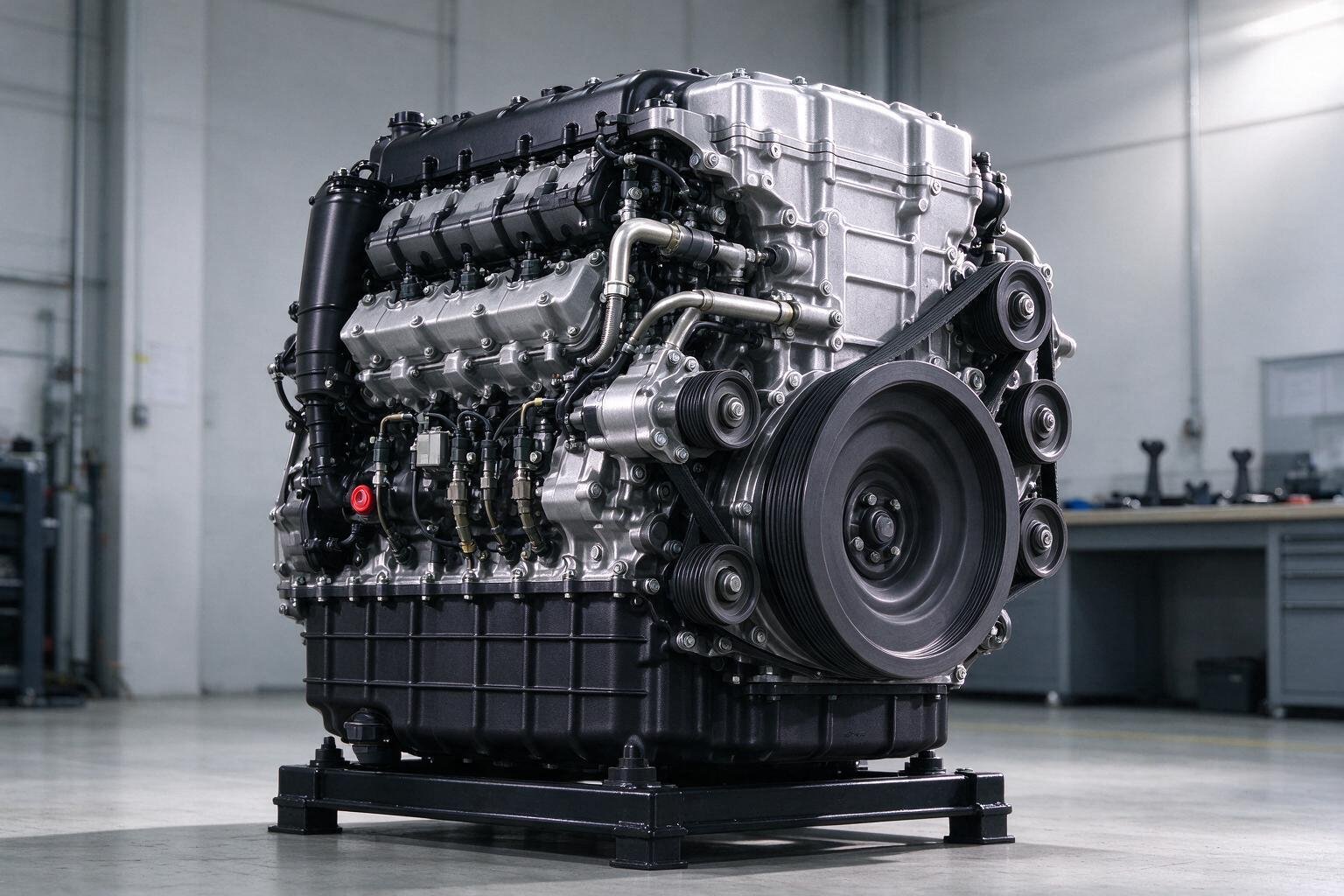
Understanding the Cummins ISX12 Platform
The Cummins ISX12 is an 11.9-liter inline-six diesel engine in the Cummins heavy-duty lineup, positioned below the larger ISX15. It saw use in on-highway tractors, vocational trucks, and some bus applications. Production ran primarily from 2010 through roughly 2016, aligned with EPA 2010 and later emissions standards. Most units use selective catalytic reduction (SCR) and a diesel particulate filter (DPF) as part of the aftertreatment package.
Common ratings fall between approximately 310 and 475 horsepower, with torque outputs from about 1,150 to 1,650 lb-ft depending on calibration and application. The engine uses a high-pressure common rail fuel system, an overhead camshaft architecture, and an integrated engine brake. These design features affect assembly configuration and pricing, since complete assemblies include the valvetrain, fuel system, and brake hardware rather than a bare block.
Buyers should confirm the exact engine code and CPL (Critical Parts List) number before ordering. Assemblies vary by rating, emissions package, and accessory layout, and a mismatched CPL can result in incompatible components.
| Specification | Typical Range |
|---|---|
| Displacement | 11.9 L |
| Configuration | Inline-six diesel |
| Production years | 2010–2016 (primarily) |
| Horsepower | ~310–475 hp |
| Torque | ~1,150–1,650 lb-ft |
| Aftertreatment | SCR and DPF |
| Fuel system | High-pressure common rail |
Verifying these details against the engine serial number and data plate reduces the risk of ordering an assembly that does not match the original build.
What an Engine Assembly Typically Includes
A Cummins ISX12 engine assembly is not a single standardized package. The scope of supply varies by supplier, and the term “complete” is used loosely across the aftermarket. Buyers should treat the component list as the primary specification document rather than relying on the listing title.
A complete assembly generally consists of the cylinder block, crankshaft, pistons and rods, cylinder head, camshaft, oil pump, and front gear train. These are the core rotating and structural components that define a rebuildable or drop-in unit. Any assembly missing one of these items is a partial build and should be priced and described accordingly.
Accessory items such as the turbocharger, fuel injectors, ECM, starter, alternator, and aftertreatment components are often excluded unless the listing states otherwise. These parts represent a significant share of total cost and are commonly reused from the original engine during a swap.
Suppliers may offer two broad configurations:
| Configuration | Included | Typical Effect |
|---|---|---|
| Long block | Block, crank, pistons, rods, cam, head; no external accessories | Lower price, higher installation labor |
| Complete drop-in | Long block plus specified accessories and covers | Higher price, reduced installation labor |
The difference materially affects both price and installation labor, so the configuration should be confirmed in writing before ordering.
Confirm whether the flywheel housing, oil pan, and valve cover are included, as these are frequently swapped from the original engine. Their absence is normal but must be accounted for during planning. Request a written component list with the quote so the scope of supply is unambiguous and can be compared directly against competing offers.
New, Remanufactured, and Used Assemblies
ISX12 assemblies are available in three main categories, and each carries a different balance of cost, risk, and documentation.
New Assemblies
New assemblies carry the highest purchase price and are typically sourced through authorized Cummins distribution channels. Build records and serial numbers are traceable, and coverage follows the manufacturer’s standard terms. Availability is the main constraint: for older ISX12 build years, new complete assemblies may be limited or discontinued, which pushes buyers toward remanufactured or used options.
Remanufactured Assemblies
Remanufactured assemblies are stripped, inspected, and rebuilt to a defined specification, often with updated components such as revised pistons, bearings, or cylinder head hardware. Documentation of the build spec matters as much as the price. Warranty terms vary by rebuilder but commonly run 12 months or longer, sometimes with mileage limits. Confirm what the warranty covers, including labour, and whether it is prorated.
Used and Take-Out Assemblies
Used or take-out assemblies are the lowest-cost route and carry the highest risk. Before purchase, verify mileage against the ECM, request service history, and check for stored fault codes, particularly those related to injector circuits, EGR, and aftertreatment. A compression or leak-down test on a take-out unit is worth the cost.
Core Charges and Total Cost
Core charges apply to remanufactured purchases and to some used sales. The core must be returned complete and rebuildable to recover the deposit; cracked blocks, damaged heads, or missing components can reduce or void the credit. Compare total cost of ownership rather than sticker price, factoring warranty terms, core fees, freight, and expected service life.
| Option | Relative cost | Warranty | Primary risk |
|---|---|---|---|
| New | Highest | Manufacturer terms | Limited availability |
| Remanufactured | Mid | 12 months or more | Rebuilder spec variance |
| Used/take-out | Lowest | Usually none | Unknown history |
Verifying Compatibility Before Purchase
Compatibility verification starts with the engine serial number (ESN). The ESN is the definitive identifier for the build configuration of a Cummins ISX12 assembly, and it should be matched against the donor unit or replacement engine before any commitment. The CPL (Critical Parts List) number should also be confirmed, as it defines the specific piston, injector, and turbocharger combination used in that build. An assembly that shares the ESN prefix but carries a different CPL may use non-interchangeable hard parts.
Emissions configuration is the next checkpoint. ISX12 assemblies built for 2010 and 2013 emissions standards differ in sensor placement, dosing valve layout, and aftertreatment architecture. The emissions certification label on the donor engine or the documentation accompanying a replacement unit should be checked against the target vehicle’s chassis and aftertreatment package.
Mechanical interface items require direct measurement or documented confirmation:
| Check | What to Confirm |
|---|---|
| Transmission interface | Bell housing bolt pattern and clutch/flywheel interface |
| Flywheel housing | SAE size (SAE 1, 2, or 3) matches the transmission and chassis |
| Rear gear train | Gear train arrangement and accessory drive layout match the vehicle |
| ECM calibration | Calibration is correct for the application and horsepower rating |
A calibration that does not match the application can trigger derate conditions, active fault codes, or reduced power complaints after installation.
For repower projects, cooling system capacity, radiator layout, and chassis mounting points should be verified before the assembly is purchased. Insufficient cooling capacity or mismatched mounting provisions can require fabrication that offsets the savings of a used or remanufactured assembly.
Inspection Checklist for Used Assemblies
A structured inspection reduces risk when evaluating a used Cummins ISX12 assembly. The following checks should be completed before purchase.
Documentation and Service History
Review service records for oil change intervals, overheating events, and prior major repairs. Extended oil drain intervals or documented overheat events warrant closer mechanical inspection.
Block and Structural Integrity
Inspect the block for cracks, especially around the main bearing saddles and cylinder liners. Magnetic particle or dye penetrant testing is preferable to visual inspection alone, as it reveals surface discontinuities that may not be visible to the eye.
Liners, Bores, and Crankshaft
Check cylinder liner protrusion and bore wear against the published specification. Confirm the crankshaft journals are within specification for diameter, taper, and out-of-round.
Valvetrain and Gear Train
Examine the camshaft lobes and followers for scoring. Verify the gear train for backlash and wear, including the camshaft and accessory drive gears.
Test Results and Debris Evidence
Request a compression test or leak-down results. Ask for photos of the oil pan interior and filter housing to check for metal debris, which can indicate bearing or valvetrain distress.
Final Mechanical Checks
Confirm the engine turns freely by hand through a complete rotation. Verify that no coolant or oil mixing is evident in either fluid circuit.
| Check | Method | Concern if Failed |
|---|---|---|
| Block cracks | Mag particle or dye penetrant | Structural rejection |
| Liner protrusion | Measurement against spec | Head gasket sealing |
| Crankshaft journals | Micrometer measurement | Bearing life |
| Cam lobes and followers | Visual inspection | Valvetrain wear |
| Gear train | Backlash measurement | Timing accuracy |
| Debris | Pan and filter photos | Internal damage |
| Rotation | Hand turning | Seizure or interference |
Warranty, Documentation, and Core Terms
Warranty coverage on a Cummins ISX12 assembly varies widely by supplier and product category. Remanufactured units commonly carry 12 to 24 months of coverage, while used assemblies may be sold as-is or with only a short start-up guarantee, sometimes limited to 30 or 90 days. Buyers should confirm the coverage period in writing rather than relying on verbal assurances from a sales representative.
The scope of coverage matters as much as its duration. A warranty may cover parts only, leaving labor for removal and installation to the buyer, or it may include labor at a stated rate. Prorated terms are also common on remanufactured units, where the credit percentage declines over the coverage period. Exclusions for overheating, improper installation, contamination, and unauthorized repairs should be reviewed before payment. The warranty document, including claim procedures and required documentation, should be obtained in writing prior to purchase.
Core acceptance criteria typically require a complete, non-cracked, rebuildable engine. Missing components such as the turbocharger, injectors, ECM, or accessory drives can reduce the core credit or disqualify the core entirely. Cracked blocks or heads, and engines with spun bearings or severe overheating damage, are commonly rejected.
| Term | Typical Range | Notes |
|---|---|---|
| Remanufactured warranty | 12–24 months | Parts and labor terms vary |
| Used assembly warranty | As-is to 30–90 days | Often start-up only |
| Core acceptance | Complete, non-cracked, rebuildable | Missing parts reduce credit |
Shipping documentation and inspection records should be retained. Photographs of the assembly at delivery, freight bills, and receiving inspection notes are frequently required to support warranty claims and core credit disputes.
Freight, Handling, and Installation Notes
A complete Cummins ISX12 assembly weighs roughly 2,300 to 2,600 lb (about 1,050 to 1,180 kg), depending on configuration and whether certain accessories are included. At this weight, the engine cannot ship via parcel carriers. It moves as crated or skidded LTL freight, typically on a pallet sized to the oil pan footprint with the assembly blocked and strapped. Buyers should confirm the crate dimensions and the shipping weight stated on the bill of lading, since LTL rates are class-based and a misdeclared weight or class can trigger reclassification fees at pickup or delivery.
Delivery logistics require attention before the shipment arrives. The buyer should confirm whether the destination is a commercial dock with a forklift rated for the load or a location that requires liftgate service. A liftgate rated at 2,500 lb or less may not safely handle a fully crated ISX12, so the carrier’s equipment capability should be verified in writing. Residential and jobsite deliveries often need a drop-deck trailer or a forklift on site.
On arrival, the shipment should be inspected before the delivery receipt is signed. Crating damage, shifted blocking, bent components, or missing accessory items should be noted on the receipt and photographed. Signing clean limits later freight claims.
Installation should follow the OEM service manual for the specific ISX12 rating and application. This covers torque specifications for mounts, bell housing, and accessory drives, oil and coolant priming procedures before first start, and any calibration or ECM updates required for the replacement assembly. Labor should be budgeted for transferring accessories from the original engine, connecting aftertreatment and harness interfaces, and running a post-installation diagnostic scan to confirm fault-free operation.
Sourcing and Price Considerations
Pricing for a Cummins ISX12 assembly depends on three primary variables: condition (used, remanufactured, or new), power rating, and the components included in the sale. A long block, a dressed drop-in assembly, and a full assembly with turbocharger and aftertreatment components occupy very different price points. Remanufactured units generally sit between used and new pricing, reflecting the cost of machining, replacement of wear items, and testing.
Lead times are driven by availability model. Stock units can ship quickly, while build-to-order remanufactured assemblies may require several weeks depending on the rebuilder’s backlog and core availability. Buyers working against a downtime deadline should confirm whether a quoted unit is on the shelf or scheduled for production.
Documentation is a key qualification criterion for any seller. The ESN-matched build sheet confirms the assembly’s configuration against the original engine serial number, and dyno test documentation verifies break-in and performance checks. Sellers unable to provide either should be treated cautiously.
Quote comparison should be itemized. Freight, core charges, and core return logistics can materially change the landed cost, and a low headline price may conceal charges that appear later. Requesting line-item quotes from multiple suppliers allows like-for-like evaluation.
For fleet buyers, standardizing on a single rebuilder can simplify warranty administration and improve parts commonality across the fleet, reducing diagnostic and inventory complexity over time.