
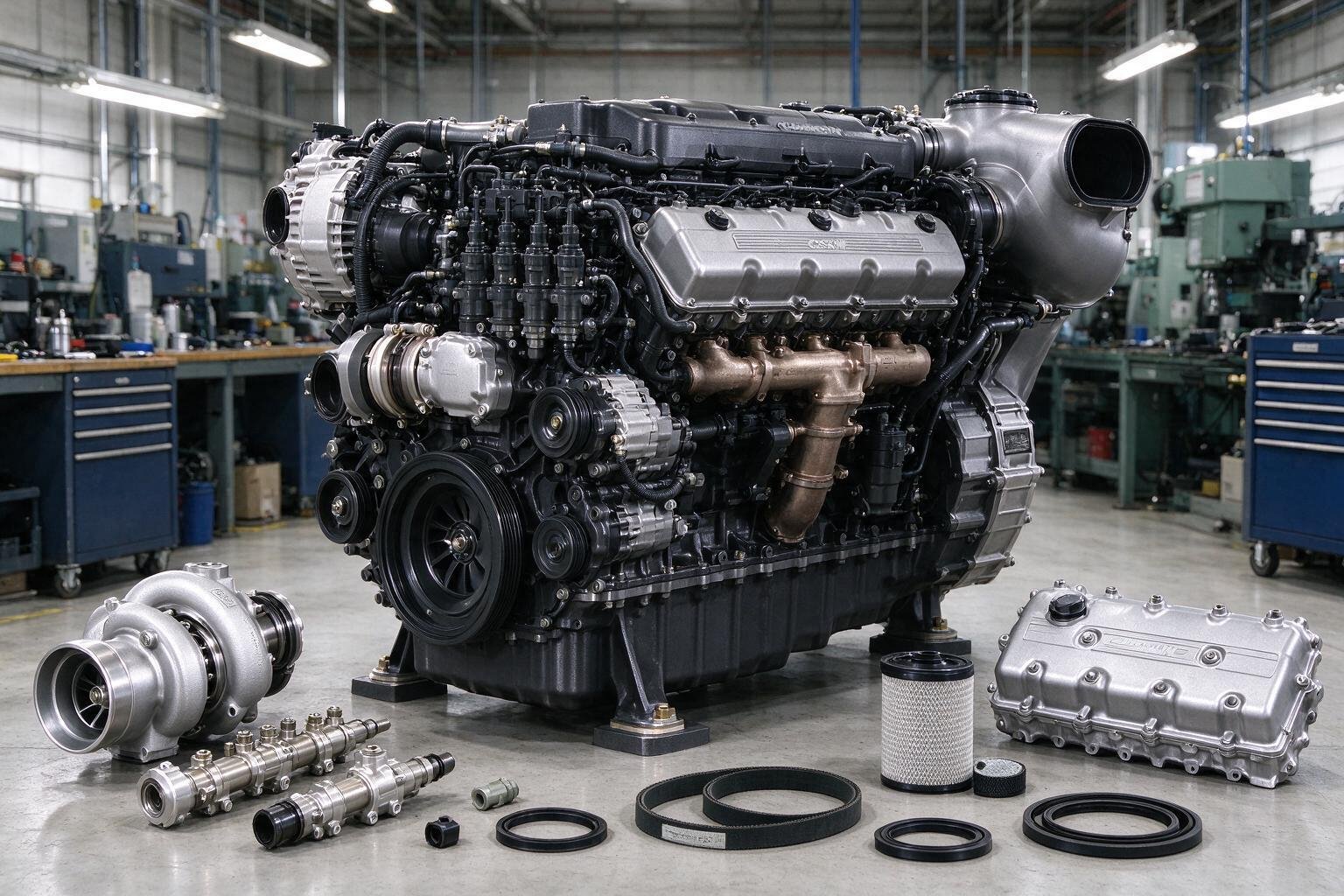
The Cummins QSK23 engine parts buying guide begins with correct engine identification, because the QSK23 is a 23-liter, inline six-cylinder industrial diesel engine used in mining haul trucks, generator sets, locomotives, and marine propulsion. Because the same base engine is configured across these applications, parts must be matched by Engine Serial Number (ESN) rather than by model name alone. The ESN is stamped on the engine dataplate and determines which parts catalog configuration applies to a given build.
Major Component Groups and Wear Patterns
The QSK23 is a 23-liter, six-cylinder engine used in mining haul trucks, generators, and other heavy-duty applications. Wear patterns vary by duty cycle, but several component groups account for most replacement demand.
Cylinder Head and Valvetrain
Valve seats, valve guides, springs, and head gaskets are high-wear items on high-hour units. Seat recession and guide wear accelerate with sustained high exhaust temperatures and frequent load cycling. Head gaskets typically require replacement whenever the head is removed for service.
Fuel System
The QSK23 uses high-pressure common rail fuel components. Injectors and high-pressure fuel pumps are sensitive to contamination, and water or debris in the fuel system can cause scoring and seizure. Injectors are commonly replaced as matched sets to maintain balance across cylinders, and fuel pump replacement often follows injector failure.
Turbocharging and Air Handling
Turbocharger cartridges, wastegate actuators, and aftercooler cores degrade with heat cycling and dust ingress. Mining environments with high silica exposure shorten turbo life unless filtration is maintained. Aftercooler cores lose heat-transfer efficiency as they foul internally.
Cooling System
Water pumps, thermostats, and oil coolers are frequent replacement items in mining and stationary applications. Continuous-duty generator sets and haul trucks with high ambient temperatures stress seals and bearings in these components.
Bottom End
Liners, pistons, rings, and bearings are replaced during in-frame and major overhauls, typically tied to oil analysis trends. Rising iron, copper, or silicon levels in oil samples indicate liner and bearing wear before visible symptoms appear.
| Component Group | Typical Wear Indicators |
|---|---|
| Cylinder head and valvetrain | Seat recession, guide clearance, gasket leaks |
| Fuel system | Injector imbalance, low rail pressure, contamination |
| Turbo and air handling | Boost loss, actuator sticking, core fouling |
| Cooling system | Seal leaks, thermostat drift, cooler restriction |
| Bottom end | Oil analysis metals, blowby, liner wear |
OEM, Genuine Remanufactured, and Aftermarket Options
QSK23 parts are available through three main channels, each with distinct trade-offs in price, traceability, and availability.
Genuine new parts from Cummins carry the highest price and the strongest traceability, with documented part numbers and revision history. For low-volume QSK23 variants, lead times can be long because production runs are scheduled around limited demand. Buyers planning major overhauls on less common ratings should confirm availability before committing to a repair window.
Genuine remanufactured components, including cylinder heads, injectors, and turbochargers, occupy a middle position. They are rebuilt to OEM specifications and typically cost less than new units, but they require core exchange. The core must be returned in acceptable condition, and core charges apply if it is cracked, excessively worn, or incomplete. Buyers should confirm core acceptance criteria before ordering.
Aftermarket parts vary widely in quality. Price alone is not a reliable indicator. Buyers should verify material specifications, dimensional tolerances, and warranty terms, and request documentation where available.
For safety-critical and fuel-system parts, evidence of testing and calibration matters more than country-of-origin claims. Flow bench data, calibration certificates, and test protocols are more useful than a label.
Mixing suppliers within a single repair, such as aftermarket injectors paired with an OEM fuel pump, can affect calibration and fuel delivery balance. Such combinations should be reviewed with the service provider before installation.
| Option | Price | Traceability | Core Required | Lead Time |
|---|---|---|---|---|
| Genuine new | Highest | Full | No | Can be long for low-volume variants |
| Genuine remanufactured | Mid | Good | Yes | Moderate |
| Aftermarket | Varies | Varies | Usually no | Often short |
Inspection and Acceptance Criteria
Receiving inspection for QSK23 components should be tied to documented evidence rather than visual assessment alone. The following criteria apply to common wear and rebuild parts.
Dimensional Records
Request dimensional inspection reports for cylinder liners, pistons, and crankshaft journals where the supplier provides them. Liner reports should show bore diameter, roundness, and taper at multiple heights. Piston records should cover skirt diameter, ring groove widths, and pin bore size. Crankshaft journal reports should list main and rod journal diameters, ovality, and taper against the specified tolerance band. Parts received without records should be measured in-house before acceptance.
Fuel System Components
Verify injector calibration data and test bench results before installation. Acceptable documentation includes flow rate at specified test points, opening pressure, and leak-down results traceable to the injector serial number. Injectors without matching calibration sheets should be set aside pending bench testing.
Cylinder Heads
Check cylinder heads for pressure testing records, valve seat concentricity measurements, and surface flatness data. Flatness should be recorded across the full deck in both axes. Pressure test results should identify the test pressure and hold time applied.
Turbochargers
Confirm turbocharger balancing reports for the rotating assembly. For variable-geometry units, also confirm actuator calibration records showing full vane travel and position feedback against the commanded range.
Gasket Sets
Inspect gasket sets for correct CPL-specific configuration before installation. Gasket mismatch is a common cause of coolant and oil leaks on QSK23 rebuilds. Compare head gasket coolant passage cutouts, intake and exhaust manifold gasket port shapes, and oil pan gasket profiles against the engine CPL. Mixed or superseded part numbers within a set should be reconciled with the parts catalog.
| Component | Required Record | Rejection Trigger |
|---|---|---|
| Liners and pistons | Dimensional report | Missing or out-of-tolerance measurements |
| Crankshaft | Journal dimensional report | Ovality or taper beyond limit |
| Injectors | Calibration and bench test data | No serial traceability |
| Cylinder heads | Pressure test, seat concentricity, flatness | Incomplete or failed results |
| Turbochargers | Balance report, actuator calibration | Missing VGT calibration |
| Gasket sets | CPL verification | Passage or port mismatch |
All records should be retained with the engine build file for warranty and traceability purposes.
Counterfeit and Misrepresented Parts Risks
Counterfeit fuel-system and turbocharger parts are a documented risk in heavy diesel markets, and the QSK23 platform is not exempt. Injectors, fuel pumps, sensors, and turbocharger cartridges are among the most frequently copied items because they carry high unit value and are difficult to inspect visually once installed.
Buyers should verify part numbers against Cummins published catalogs rather than relying on supplier listings alone. Packaging should be checked for print quality, correct labelling, and intact seals. Casting marks on housings and brackets should be compared with known genuine examples, and serial traceability should be confirmed where the part carries a serial number. Mismatched or missing traceability is a reason to hold the order.
Price is a useful screening signal. Injectors, sensors, and ECM components offered far below prevailing market levels warrant scrutiny, particularly when lead times are unusually short or the seller cannot explain the source of stock.
Suppliers of branded parts should be asked to document their sourcing channels in writing. A purchase invoice from an authorized distributor, or equivalent chain-of-custody documentation, is reasonable to request before committing to a large order.
Incoming parts should be photographed and recorded on receipt, including packaging, labels, part numbers, and casting marks. This record supports warranty claims and dispute resolution if a part is later found to be counterfeit or misrepresented.
| Check | Action |
|---|---|
| Part number | Verify against Cummins published catalog |
| Packaging | Inspect print quality, labels, seals |
| Casting marks | Compare with known genuine examples |
| Serial traceability | Confirm serial present and consistent |
| Price | Compare against prevailing market levels |
| Sourcing | Request written channel documentation |
| Receiving | Photograph and log all incoming parts |
Sourcing Checklist for International Buyers
International procurement of Cummins QSK23 components carries risks that are manageable with structured verification. The checklist below covers the points that most often separate a smooth transaction from a costly dispute.
Confirm ESN and CPL quoting. The QSK23 was produced in multiple configurations, and part numbers can change across build phases. A supplier should quote against the engine serial number (ESN) and the control parts list (CPL), not the engine model alone. Buyers should provide both identifiers and expect the quotation to reference them. Suppliers who quote only “QSK23” risk shipping components that fit the block but not the specific build.
Establish commercial terms up front. Request lead times per line item, minimum order quantities, and the applicable Incoterms: FOB, CIF, or DDP. Each term shifts freight liability, insurance, and customs responsibility differently, so the choice should match the buyer’s logistics capability and import experience.
Clarify warranty and core policy. Confirm warranty duration and what it covers, the core return policy including the core acceptance criteria, and which party pays return freight on warranty claims and core rejects. Ambiguity here is a common source of post-sale disputes.
Request application-specific references. Ask for references from buyers running similar duty cycles: mining haul trucks, marine propulsion, or prime/standby power generation. Duty cycle affects wear patterns and parts selection, so comparable references are more meaningful than general ones.
Verify export documentation and packing. Confirm the supplier can provide commercial invoices, packing lists, certificates of origin, and correct HS codes for each shipment. Heavy components such as cylinder heads, crankshafts, and cylinder blocks require export-grade packing with adequate crating and corrosion protection for ocean freight.
| Verification Item | What to Request |
|---|---|
| Part identification | Quote referencing ESN and CPL |
| Commercial terms | Lead time, MOQ, FOB/CIF/DDP |
| After-sales | Warranty terms, core policy, freight liability |
| References | Buyers in mining, marine, or power generation |
| Export compliance | HS codes, documentation set, packing standard |
Lead Times, Stocking, and Total Cost of Ownership
The QSK23 is a low-volume engine relative to Cummins’ high-production platforms, and parts availability reflects that. Many components, particularly those specific to the QSK23 rather than shared with other QSK series engines, are not held in deep inventory by distributors and may require weeks of lead time. Planned overhauls and major services should be scheduled with this in mind, with parts ordered well ahead of the engine coming out of service.
For remote operations, holding critical spares on site is a practical risk control. Injectors, sensors, the water pump, and complete gasket sets are the items most likely to cause extended downtime if they must be ordered after a failure is identified. The carrying cost of these parts is generally modest against the cost of an idle engine.
Total cost of ownership analysis should not rely on part price alone. Service life, the effect of the part on fuel efficiency, and failure risk all affect the real cost. A lower-priced injector with a shorter service interval or degraded spray pattern can cost more over an overhaul cycle than a higher-priced unit. The same logic applies to sensors and pumps.
Fleet operators commonly buy consumables in bulk. Filters, gaskets, and seals are predictable items with stable demand, and volume purchasing reduces per-unit cost and order frequency.
Stocking decisions are best driven by data. Tracking replacement intervals by engine serial number (ESN) allows operators to see actual service life for each part on each engine and to build a stocking plan based on observed failure and replacement patterns rather than generic schedules.
| Part category | Typical stocking approach |
|---|---|
| Injectors, sensors, water pump | Hold on site for remote operations |
| Gasket sets | Hold one complete set per engine |
| Filters, seals | Bulk purchase for fleets |
Frequently Asked Questions
Can parts be selected by engine model alone?
No. The QSK23 designation covers a range of ratings and configurations, and parts that fit one build may not fit another. Accurate matching requires the Engine Serial Number (ESN) and the Control Parts List (CPL) number. The ESN identifies the specific build, including its rating and emissions configuration, while the CPL defines the exact combination of components approved for that engine. Suppliers who ask only for the model are likely working from incomplete data. Buyers should provide both numbers with any inquiry and confirm that the seller verifies fitment against them before shipping.
Are aftermarket injectors interchangeable with OEM units?
Only when calibration and specifications match. Injectors are calibrated to deliver a specific fuel quantity and spray pattern for a given rating and CPL. An aftermarket unit may physically install but still deliver incorrect flow, affecting power, emissions, and combustion temperatures. Buyers should request test data covering flow rate, calibration code, and spray characteristics, and compare it against the OEM specification for the ESN. Units without verifiable test documentation carry higher risk on a high-horsepower industrial engine.
What is a core charge?
A core charge is a refundable deposit added to the price of a remanufactured component. It is returned when the old component is sent back in acceptable condition for remanufacturing. Core eligibility typically depends on the returned part being complete, not cracked, and of the correct part number. Buyers should confirm the core amount, return window, and shipping terms before ordering.
How long should QSK23 major components last?
Service life depends on duty cycle, maintenance practice, and fuel quality. Engines in continuous generator duty accumulate hours differently from intermittent haul applications. Oil analysis is the practical guide for replacement timing: rising wear metals, viscosity changes, or coolant contamination indicate internal condition better than hour counts alone.