
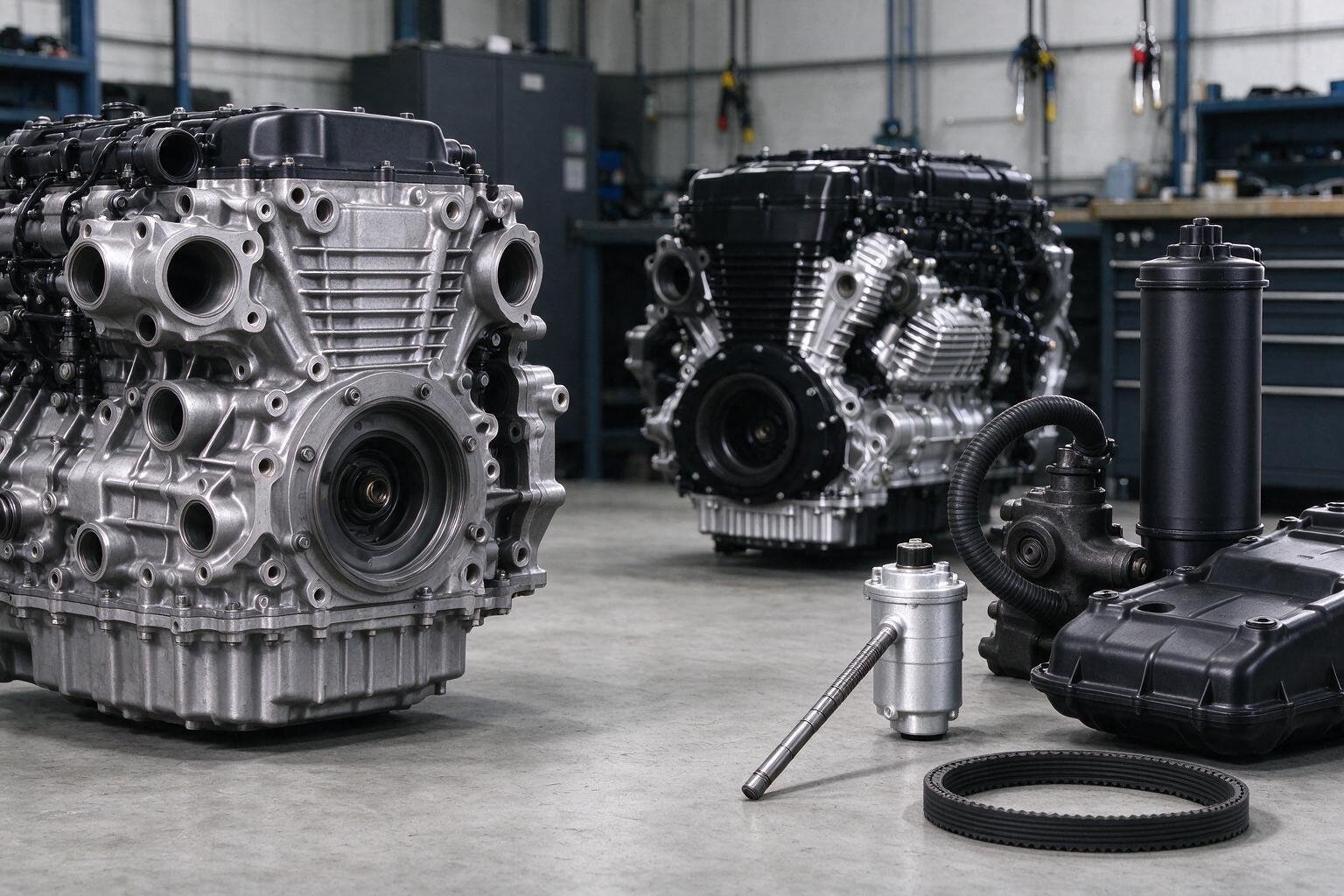
This Cummins ISX engine parts buying guide begins with the platform itself: the ISX is a 15-liter inline-six diesel introduced to meet 1998-2002 emissions tiers. It was produced across several generations: the original ISX (pre-2002), the ISX 2002, the ISX 2004, and the ISX15, which ran from 2007 through 2013 and beyond on the CM871, CM2250, and CM2350 ECM platforms. Because parts are not interchangeable across all generations, cylinder heads, injectors, pistons, and turbochargers differ by build year, ECM calibration family, and emissions configuration. The ISX15 and earlier ISX share displacement, but fuel systems changed from the older STC injectors to later common-rail-era designs, and aftertreatment strategy evolved as well. Buyers should confirm the exact CPL (Critical Parts List) number before ordering.
Decoding Cummins Part Numbers and CPL Data
Cummins part numbers follow a seven-digit format, typically seen as 4089xxx, 4955xxx, or 2881xxx. The leading digits group parts by commodity. Numbers beginning with 3 or 4 cover hard engine parts such as cylinder heads, pistons, and bearing sets. Numbers beginning with 2 designate electronics and sensors, including ECMs and position sensors. Numbers beginning with 5 generally identify gasket and hardware sets. Recognizing the prefix narrows the search before any lookup begins.
Suffix letters carry meaning beyond the base number. A part listed as 4955385 differs from 4955385RX. The RX suffix typically indicates a Cummins ReCon remanufactured part, which carries warranty terms distinct from a new component. Buyers comparing prices should confirm whether a listing is new, remanufactured, or a revised configuration, since the suffix changes both the part’s condition and its coverage.
The CPL (Control Parts List) is a four-digit code that defines the exact parts combination used to build a given engine. It fixes injector trim, piston design, and turbocharger match for that serial range. Cross-referencing a part number against the CPL is the standard method for avoiding mismatched components. This matters most for injectors and pistons, where trim codes determine whether a part performs correctly in a specific build.
Aftermarket suppliers often publish interchange lists mapping their numbers to Cummins references. These lists are a starting point, not a final authority. Each cross-reference should be verified against the OEM CPL for the engine in question rather than accepted at face value.
| Prefix | Category | Example |
|---|---|---|
| 2xxxxxx | Electronics and sensors | 2881xxx |
| 3xxxxxx / 4xxxxxx | Hard engine parts | 4089xxx, 4955xxx |
| 5xxxxxx | Gasket and hardware sets | 4955xxx |
High-Wear Components and Typical Replacement Intervals
Several ISX components carry predictable wear profiles, and understanding them helps buyers plan parts purchases around service events rather than failures.
Injectors
Injectors are a known wear item across the ISX family. Earlier STC (step timing control) injectors and later electronic units differ in service life and in how they are matched to the engine. Replacement injectors must carry trim codes matching the ECM calibration; mismatched codes can cause rough running, fueling errors, or fault codes. Buyers should confirm the correct injector variant and trim code for the specific engine serial number before ordering.
Turbochargers
Many ISX builds use Holset HE400 or HX55 family turbochargers. Actuator, bearing, and wastegate wear are typical over time. On 2007 and later units with variable geometry, the VGT actuator is a frequent failure point and is often replaced separately from the turbocharger assembly.
EGR Coolers
EGR coolers on 2002–2010 ISX engines are prone to coolant-side fouling and internal leaks. Cooler replacement is commonly folded into major service work rather than handled as a stand-alone repair.
Cylinder Head and Gasket
Higher-mileage ISX15 units may develop head and gasket issues that require replacement or resurfacing at overhaul. Buyers should verify deck flatness specifications and head casting numbers before purchasing.
Overhaul Items
Oil pumps, water pumps, and air compressors are commonly replaced at major overhaul intervals, often cited around 500,000 to 750,000 miles depending on duty cycle.
| Component | Typical Service Point |
|---|---|
| Injectors (STC / electronic) | Wear item; trim code match required |
| Turbocharger (HE400/HX55) | Actuator, bearing, wastegate wear; VGT actuator on 2007+ |
| EGR cooler | 2002–2010 units; fouling and internal leaks |
| Cylinder head/gasket | Higher-mileage ISX15; overhaul |
| Oil pump, water pump, air compressor | Major overhaul, ~500,000–750,000 miles |
New, Remanufactured, and Aftermarket Parts: What to Compare
Buyers sourcing parts for the Cummins ISX face three distinct supply paths, each with different traceability and risk profiles.
New OEM Parts
New OEM parts carry the Cummins part number and full traceability to the original production specification. They serve as the reference standard for fit, function, and warranty coverage. For any component where dimensional accuracy or calibration affects engine protection, new OEM parts remove the variability question entirely.
Cummins ReCon Remanufactured Parts
Cummins ReCon remanufactured parts, identified by the RX suffix on the part number, are rebuilt to OEM specification and typically carry a warranty comparable to new. Two commercial factors apply: a core charge is assessed at purchase and refunded when the old unit is returned, and core acceptance rules govern condition. Cracked castings, missing components, or prior disassembly can reduce or void the core credit. Buyers should confirm core criteria before ordering.
Aftermarket Parts
Aftermarket parts vary widely in metallurgy, machining tolerances, and injector calibration. Quality ranges from near-OEM to unsuitable for the application. Buyers should request material certifications and flow-test data where available, particularly for fuel system components.
Where the Cost Gap Matters
For high-stress components such as injectors, turbochargers, and cylinder heads, the lower purchase price of aftermarket parts is often offset by shorter service life, calibration drift, or repeat labor. On the ISX, injector calibration errors can affect fuel delivery balance and cylinder loading.
Lower-Risk Categories
Consumables such as gaskets, filters, and hardware are lower-risk areas for aftermarket sourcing, provided specifications match: gasket material composition, filter efficiency ratings, and fastener torque and grade requirements should be verified against the OEM specification before installation.
Inspection Criteria Before Purchase or Installation
Verification begins with the engine identification data. The part number should be checked against the engine’s Critical Parts List (CPL) and the build dataplate, since Cummins ISX variants across different years and horsepower ratings use components that are not always interchangeable. Photographing the dataplate before ordering creates a record of the CPL and serial number that simplifies later warranty or fitment disputes.
On injectors, the trim code is the critical check. The trim code on each injector must match the calibration stored in the ECM. A mismatched trim code typically produces rough running, misfire codes, and poor fuel economy, and no amount of mechanical inspection will catch it once the part is installed. Compare the code on the injector body against the ECM calibration record before accepting delivery.
Cylinder heads warrant close visual and dimensional inspection. Look for cracks between the valve seats, which are common on high-hour ISX heads and usually condemn the casting. Check flatness with a straightedge against the OEM limit, and measure valve guide clearance for wear beyond specification.
For turbochargers, check axial and radial shaft play, inspect the compressor wheel for blade damage or contact marks, and verify actuator response. Variable geometry turbocharger (VGT) actuators should be bench-tested where equipment allows, since a sticking actuator can mimic a boost fault.
Remanufactured parts should arrive with documentation of the rebuild process, including what was replaced and to what specification. Confirm the core acceptance criteria before shipping a core back, as cracked castings or contaminated assemblies are commonly rejected.
Sourcing Checks for International Buyers
International sourcing of Cummins ISX components carries risks that domestic purchasing does not, particularly around documentation, part identity, and after-sales recourse. Buyers should apply a consistent verification process before committing to an order.
Part identification. Request the Cummins part number, the CPL (Control Parts List) reference, and the serial number range the part fits. The CPL is the definitive link between an engine configuration and its correct components; a supplier unable to state it cannot confirm fitment. Suppliers who cannot provide these details should be treated with caution.
Classification and export documentation. Ask for packing list details, country of origin, and whether the part is new, remanufactured, or aftermarket. Export documentation and duty rates depend on this classification, and misdeclaration can delay clearance or create liability for the importer.
Warranty terms. Confirm warranty terms in writing, including coverage duration, the claim process, and whether labor is included. Verbal assurances are difficult to enforce across borders.
Bulk order verification. For bulk orders, request a sample or arrange pre-shipment inspection. Verify weights and dimensions against OEM specifications; deviations can indicate counterfeit or mislabeled parts.
Technical capability. Check that the supplier can cross-reference against Cummins CPL data and provide technical support for installation questions. A supplier without this capability is unlikely to resolve fitment disputes after delivery.
| Check | What to Request | Red Flag |
|---|---|---|
| Part identity | Part number, CPL, serial range | Cannot state CPL |
| Classification | Origin, condition (new/reman/aftermarket) | Vague or inconsistent |
| Warranty | Written terms, claim process, labor coverage | Verbal only |
| Bulk verification | Sample or pre-shipment inspection | Refuses inspection |
| Technical support | CPL cross-reference, installation guidance | No data access |
Overhaul Planning and Parts Kits
A major overhaul on a Cummins ISX typically includes cylinder kits (piston, liner, rings), bearing sets, gasket sets, head bolts, injectors, oil pump, and water pump. Each of these items should be selected against the engine’s specific CPL (Critical Parts List), which defines the correct configuration for that build.
Kit Selection and CPL Matching
Overhaul kits should be assembled against the specific CPL. Generic kits may include parts that do not match the engine’s emissions configuration, particularly where piston design, injector trim, and aftertreatment compatibility differ between ratings and model years. Verifying each kit component against the CPL before ordering avoids mismatched parts discovered mid-build.
Machining Allowances
Plan for machining operations such as block decking, head resurfacing, and line boring. Confirm whether the chosen parts tolerate the planned machining allowances; piston protrusion, liner height, and valve recession limits all depend on the final machined dimensions. Parts selected before machining requirements are known can leave insufficient material for correction.
Core Returns
Track core returns for remanufactured injectors and turbochargers. Core charges can represent a significant portion of total cost if cores are rejected, and rejection commonly results from missing components, damage, or late return outside the accepted window. Cores should be inspected, tagged, and shipped according to the remanufacturer’s criteria.
Documentation
Document all part numbers installed for future service reference and warranty claims. A complete record of kit numbers, injector trim codes, and serialized components supports later diagnostics and substantiates claims if a failure occurs within the coverage period.
Common Buying Mistakes to Avoid
Part ordering errors on the Cummins ISX platform usually trace back to a small set of recurring mistakes. Each is avoidable with the right reference data before the order is placed.
Ordering by model year without confirming the CPL
The most frequent cause of wrong-part returns is ordering by model year alone. Cummins assigns a Control Parts List (CPL) number to each engine build, and the CPL, not the calendar year, defines the correct configuration for pistons, injectors, turbochargers, and other components. Two ISX engines built in the same year can carry different CPLs and different part numbers. The CPL is stamped on the engine dataplate; it should be recorded and quoted on every order.
Assuming ISX and ISX15 parts are interchangeable
The ISX15 is an evolution of the ISX platform, not a direct substitute across all years. Fitment dimensions and ECM calibration strategies changed over the production run. Mixing parts across generations can produce installation interference, incorrect sensor readings, and calibration faults that are difficult to diagnose after the fact.
Overlooking injector trim codes and ECM calibration
Replacement injectors carry trim codes that must be programmed into the ECM. Failing to match trim codes, or installing injectors that do not correspond to the ECM calibration, causes rough running, derate events, and emissions faults. Confirm that the replacement injector part number is compatible with the engine’s current calibration before installation.
Buying low-cost injectors or turbos without test data
The lowest-priced aftermarket injectors and turbochargers frequently lack documented flow bench or balance test results. Without test data, repeat failures and unplanned downtime become likely. Request test documentation as part of the quote.
Ignoring core charges and return shipping
Remanufactured pricing often assumes a core credit. Core charge terms, core inspection criteria, and return shipping costs can erase the apparent savings if the old unit is rejected or shipped at the buyer’s expense. Read the core policy before purchase.