
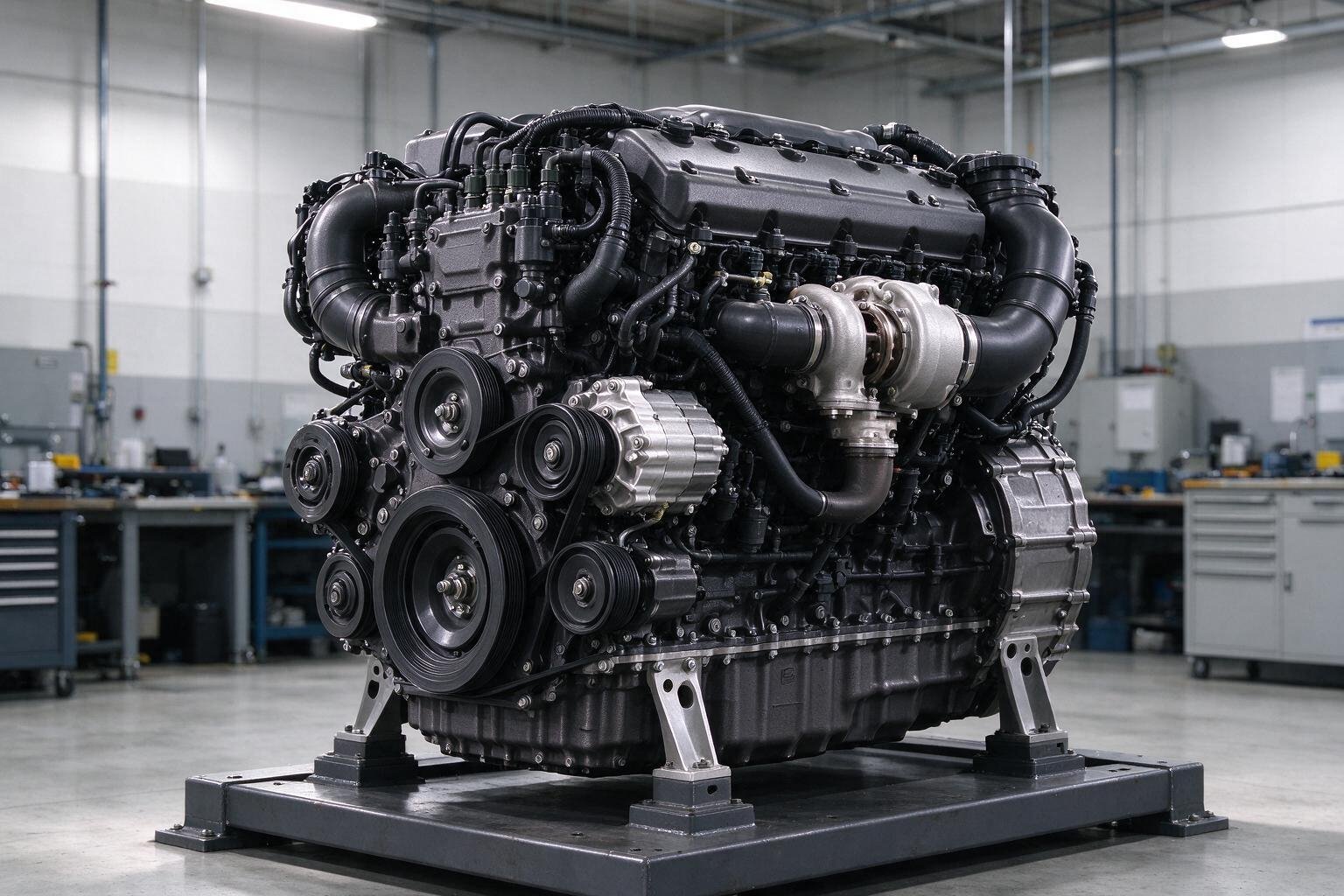
Understanding the Cummins ISX Engine Assembly
The Cummins ISX is a heavy-duty diesel platform produced in two primary displacements: the ISX15 at 14.9 liters and the ISX12 at 11.9 liters. Both are common in Class 8 tractors and vocational equipment such as dump trucks, mixers, and heavy haulers. The platform has been in service across several emissions generations, which has a direct effect on how assemblies are sourced and priced on the secondary market.
An “engine assembly” is not a standardized term. In practice it usually means a complete drop-in unit: block, cylinder head, and rotating assembly, often with the fuel system, turbocharger, and accessories included, depending on the seller’s definition. Because that definition varies, buyers should confirm exactly what category a quoted assembly falls into before comparing prices.
| Category | Typical contents | Price position |
|---|---|---|
| Long block | Block, head, rotating assembly; no fuel system, turbo, or accessories | Lowest |
| Complete running engine | Long block plus fuel system, turbo, harness, and accessories; tested | Highest |
| Dressed take-out | Used engine removed from a donor vehicle with most external components intact | Mid-range |
ISX engines span EPA 2007, EPA 2010, and later configurations. The 2007 and 2010 versions differ in EGR, DPF, and dosing hardware, and the ECM calibration and aftertreatment strategy must match the chassis the engine is going into. A 2010 assembly installed in a 2007 application, or the reverse, will require ECM and harness work that is not reflected in the base assembly price. Confirming the engine serial number, CPL, and emissions family before purchase avoids mismatches that surface only during installation.
Primary Assembly Categories and Typical Price Bands
Complete Cummins ISX assemblies trade in three broad categories, and each carries a distinct pricing profile. Buyers comparing quotes should confirm which category a given figure represents before treating it as comparable.
Used Complete Assemblies
Used take-out assemblies generally sit at the low end of the market. The final figure is driven by condition, documented mileage, and paperwork: service records, prior rebuild history, and a verifiable serial number all support a higher position within the used band. Assemblies with unknown history or visible wear typically price lowest. A compression test, oil analysis, or boroscope inspection is commonly used to validate condition before purchase.
Rebuilt Assemblies
Rebuilt assemblies, whether from a remanufacturer or a local machine shop, occupy the middle of the market. Pricing reflects the scope of the rebuild (whether the head, injectors, liners, and bearings were replaced or reconditioned) and the warranty offered. Shop rebuilds with limited coverage price below full reman programs with documented inspection and dyno testing.
New and Factory-Reman Assemblies
New or factory-reman complete assemblies carry the highest price and the strongest warranty coverage. The premium reflects full component replacement, documented testing, and longer coverage terms, which matter most in high-utilization fleets where downtime cost exceeds the price difference.
| Category | Relative Price | Typical Warranty |
|---|---|---|
| Used complete | Low | As-is or short |
| Rebuilt (shop or reman) | Mid | Limited to moderate |
| New / factory-reman | High | Longest |
Prices fluctuate with core availability, freight costs, and regional demand. Any figure should be treated as a range rather than a fixed quote, and confirmed against current market listings and carrier rates.
ISX15 vs. ISX12: How Displacement Affects Price
The Cummins ISX platform spans two displacements, and that difference shapes both availability and pricing on the used and remanufactured assembly market.
The ISX15 is the more common highway and heavy-haul platform. Its larger production volume means used supply is deeper, and buyers typically see more competitive pricing because multiple assemblies are usually available at any given time. The ISX12 serves regional and vocational applications, where production volume was lower. As a result, certain ISX12 configurations can be harder to source, and limited availability often pushes prices higher relative to comparable ISX15 assemblies.
Horsepower rating and torque calibration within each displacement also affect price. A higher-output calibration generally carries more value in the core, and matching the original rating is necessary for correct replacement. Buyers who substitute a different rating risk drivetrain and emissions compatibility issues that add cost beyond the assembly itself.
Matching the CPL (Critical Parts List) number is the primary check for compatibility. The CPL identifies the specific parts configuration of the original engine, including emissions hardware and accessory mounting. A replacement assembly with a different CPL may require additional parts or calibration work to function correctly in the existing chassis.
| Factor | ISX15 | ISX12 |
|---|---|---|
| Primary application | Highway, heavy-haul | Regional, vocational |
| Used supply depth | Deeper | Shallower |
| Typical pricing pressure | More competitive | Less competitive on some configurations |
| Sourcing difficulty | Generally lower | Higher for certain configurations |
Buyers should confirm the CPL and original horsepower rating before purchase, since both influence core value and the total cost of a correct replacement.
Cost Drivers Beyond the Base Assembly Price
The quoted price of a Cummins ISX engine assembly rarely reflects the full transaction cost. Several line items sit outside the base figure and should be confirmed before any purchase order is issued.
Core charges
Most remanufactured and rebuilt programs require a rebuildable core, with the charge refundable once the returned unit is inspected and accepted. A cracked block, a non-matching serial or CPL, or missing external components can reduce or void the credit, turning an expected refund into an added cost.
Freight and lifting
A complete ISX assembly weighs well over 1,000 kg. It moves on a flatbed or specialized carrier, and a crane or forklift is needed at both the shipping and receiving ends. Liftgate service, residential delivery, and inside delivery are typically excluded from standard freight quotes.
Installation labor
Removal and reinstallation hours vary by chassis. A tight engine bay in a vocational truck or bus can add significant time compared with a conventional highway tractor. Labor can represent a meaningful share of the total project cost.
Ancillary parts
Injectors, turbocharger, EGR cooler, and aftertreatment components are frequently priced separately from the long block or assembly. Any quote should itemize these parts and state whether they are new, remanufactured, or reused from the core.
Warranty terms
Longer coverage periods and included labor allowances generally raise the headline price. The trade-off is reduced financial exposure if a failure occurs during the coverage window.
| Cost item | Typical treatment |
|---|---|
| Core charge | Refundable on accepted core |
| Freight and lifting | Often excluded from base quote |
| Installation labor | Billed separately, chassis-dependent |
| Ancillary parts | Itemized per component |
| Warranty | Included in headline price |
What a Quote Should Itemize
A Cummins ISX assembly quote is only useful for comparison when it is specific enough to price against another supplier’s offer. Vague line items such as “ISX long block” or “rebuilt engine” leave the buyer unable to determine what is actually being purchased.
Engine identification. The quote should state the exact engine model (for example, ISX15), the CPL number, and the emissions configuration. ISX engines were produced in multiple configurations across model years, and the CPL determines the correct pistons, injectors, camshaft, and calibration. A quote without a CPL is not a firm quote.
Assembly scope. The quote must distinguish between a long block and a complete running engine, and list which accessories are included: oil pan, valve cover, front cover, water pump, oil cooler, turbocharger, injectors, fuel pump, ECM, and harness. Accessory content is often the largest source of price variance between suppliers.
Rebuild specification. Where a rebuilt assembly is quoted, the specification should indicate whether the block was line-bored and decked, whether the crankshaft was turned or replaced, and whether the cylinder head was reconditioned or replaced. Parts brands for pistons, bearings, gaskets, and the head gasket should be named.
Core charge. The core charge amount and acceptance conditions should be stated: completeness, crack-free status, and whether freight on the core return is prepaid.
Warranty. Duration, mileage limit, and whether labor is covered should be specified in writing.
Freight. Terms should name the delivery point (dock or jobsite), the carrier, and who is responsible for unloading.
| Item | Detail required |
|---|---|
| Engine | Model, CPL, emissions configuration |
| Scope | Long block or complete engine; accessory list |
| Rebuild | Machining performed; parts brands |
| Core | Charge amount; acceptance conditions |
| Warranty | Duration, mileage, labor coverage |
| Freight | Terms, delivery point, unloading responsibility |
Used, Rebuilt, or Reman: Matching Option to Application
Buyers comparing Cummins ISX engine assembly price across the three main supply routes should match the option to the duty cycle and the remaining life expected from the machine, not to the lowest line item alone.
Used assemblies
Used ISX assemblies suit budget-constrained repairs and older equipment where residual service life expectations are moderate. A used drop-in can restore a truck or piece of equipment to service at the lowest acquisition cost, but condition varies widely with donor mileage, maintenance history, and the reason the donor engine was removed. Used units are typically the right fit for low-utilization or seasonal equipment, or for machines nearing retirement where a full rebuild cannot be justified.
Rebuilt assemblies
Rebuilt assemblies offer a middle path when documentation of machine work and parts is provided. A credible rebuild record should identify the machine shop, the machining operations performed (cylinder boring or honing, deck resurfacing, line bore check), the part brands installed, and the torque and clearance specifications used. Without that paperwork, a rebuilt engine is difficult to distinguish from a used one on price or on expected life.
Factory reman or new
Factory reman or new assemblies make sense for high-utilization fleets where downtime cost and warranty certainty outweigh the higher purchase price. In line-haul or continuous-duty service, the warranty term and the consistency of the build often offset the price premium within the first years of operation.
Documentation to request
For any option, request the engine serial number history and, where available, oil analysis or run-test records. Serial number history confirms the CPL and configuration match; run-test and oil data give the best available signal of internal condition before purchase.
| Option | Best fit | Documentation priority |
|---|---|---|
| Used | Budget repairs, older or low-utilization equipment | Serial history, donor mileage, run records |
| Rebuilt | Mid-life equipment needing documented work | Machine shop records, parts list, specifications |
| Reman or new | High-utilization fleets | Warranty terms, build certification |
Verification and Compatibility Checks Before Purchase
An ISX assembly is only a direct replacement when the configuration data matches the vehicle it will serve. Buyers should treat the following checks as mandatory before releasing payment or accepting a remanufactured exchange.
ECM Calibration and CPL
The engine control module calibration and the Critical Parts List (CPL) must match the vehicle’s original configuration. A mismatched CPL can change injector trim, turbocharger matching, and sensor scaling, which typically produces derate events or emissions-related fault codes. Request the CPL number and calibration code from the seller and compare them against the OEM build record or the original ECM data.
Driveline Interface
Confirm that the flywheel housing and bellhousing bolt pattern suit the transmission in the chassis. Housing SAE size and starter location vary across ISX applications, and an incorrect housing requires replacement before installation.
Front-End Accessory Drive
Verify the accessory drive and fan hub arrangement against the chassis. Pulley count, belt routing, fan hub offset, and fan clutch mounting differ between applications, and a mismatched front end can prevent the fan from clearing the radiator shroud.
Aftertreatment Compatibility
For EPA 2010 and later units, confirm aftertreatment compatibility, including DPF and SCR configuration and sensor architecture. Mixing emissions generations creates compliance problems and can prevent the ECM from completing a successful regeneration cycle.
Core Inspection
Before accepting a reman exchange, inspect the core for external cracks, cylinder sleeve condition, and main bearing bore integrity. Bore alignment and sleeve protrusion should be measured where records allow.
| Check | Confirm Against |
|---|---|
| ECM calibration and CPL | OEM build record or original ECM |
| Flywheel housing and bellhousing | Transmission model in chassis |
| Accessory drive and fan hub | Chassis front-end layout |
| Aftertreatment generation | EPA model year (2010+) |
| Core condition | Crack, sleeve, and bore inspection |
Summary: Building a Realistic Budget
A Cummins ISX engine assembly price is not a single figure. Buyers should budget for several line items beyond the assembly itself: the core charge, freight, installation labor, and a contingency for ancillary parts such as gaskets, seals, filters, coolant, and fasteners. The core charge is typically refundable only when the old assembly is returned in acceptable condition, so it should be treated as working capital tied up for the duration of the exchange rather than a permanent cost. Freight varies with shipping distance, liftgate or dock access, and whether the assembly ships on a pallet or in a crate.
Quotes should be compared on an itemized basis rather than on headline price alone. A lower advertised figure may exclude the core deposit, exclude freight, or assume a long block configuration that requires reuse of existing components. Itemized comparison exposes these differences and allows an accurate total cost of ownership calculation.
Sellers should be prioritized when they can document rebuild scope, parts provenance, and warranty terms in writing. Documentation of what was machined, what was replaced, and which parts are OEM or aftermarket establishes the basis for later warranty claims. Written warranty terms should specify coverage duration, labour allowances, and exclusions.
The Cummins ISX engine assembly price should be treated as a range shaped by configuration (long block versus complete drop-in), condition (new, remanufactured, or used), and support terms (warranty length and documentation). Buyers who budget against the range, including all ancillary costs, avoid the shortfall that comes from planning around a single quoted number.