
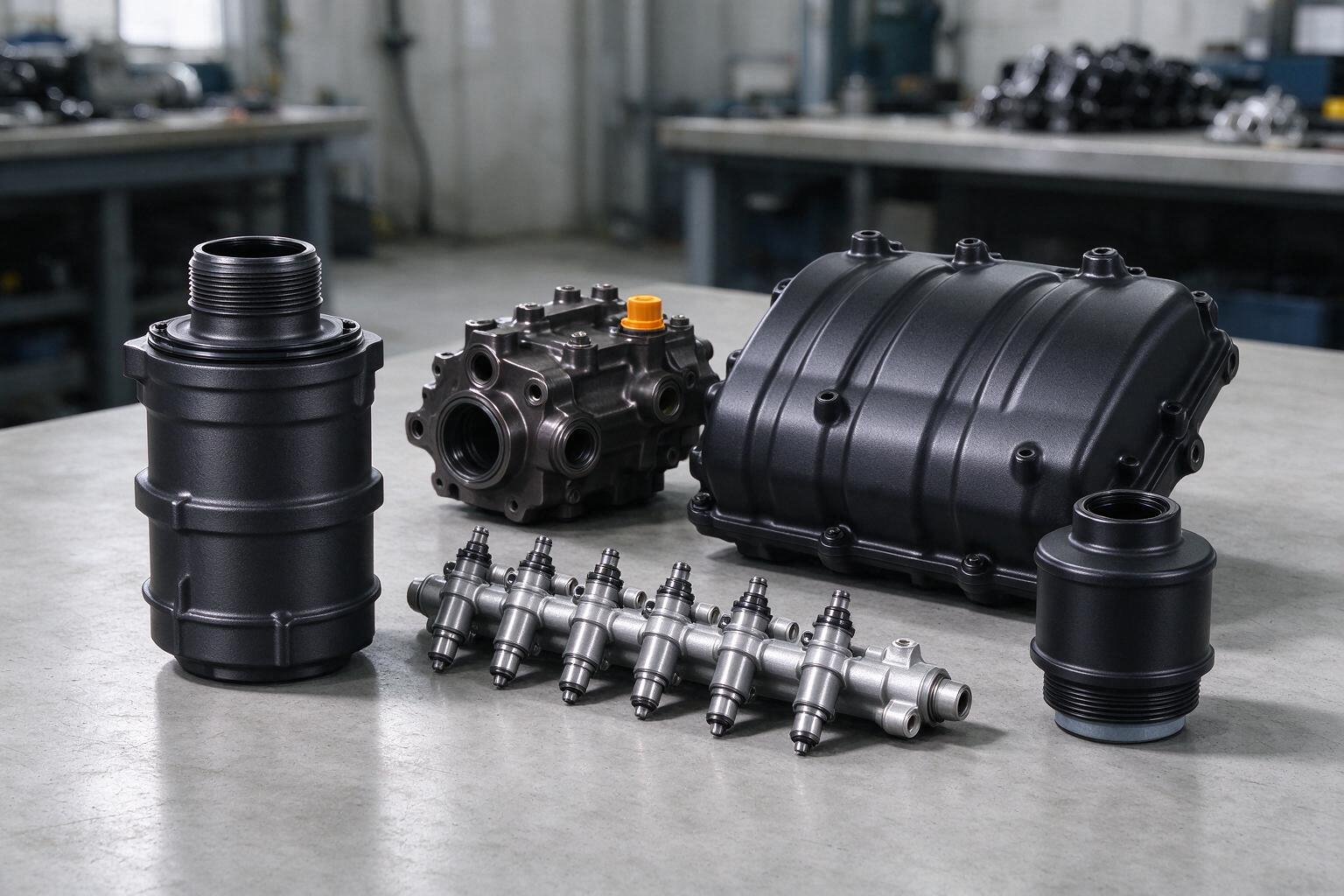
Learning how to identify genuine Cummins engine parts matters because counterfeit components can differ from the original specification in ways that are not visible on a visual comparison alone. Knowing how to identify genuine Cummins engine parts starts with understanding where non-genuine parts most often diverge: metallurgy, heat treatment, and dimensional tolerances. A counterfeit injector body may use a different alloy grade, a replacement fastener may lack the specified hardness after heat treatment, and a filter or gasket may sit outside the original tolerance band. These differences affect fatigue life, sealing, and wear rates under load, and they may not surface until the engine has accumulated significant hours.
Start With the Engine Serial Number (ESN)
The engine serial number is the primary reference for confirming which part variant fits a given engine build. Cummins produces engines in many configurations, and the same nominal component can differ by calibration, emissions tier, and production change. The ESN resolves those differences at the level of the individual engine rather than the model family.
The ESN appears on the engine data plate, typically an eight-digit number, sometimes followed by a suffix letter. The data plate is usually mounted on the engine block or valve cover; the exact location varies by engine series, so the plate should be located before ordering any fitment-critical part. The suffix letter is part of the identifier and should be recorded along with the digits.
Cummins parts catalogs and dealer systems map the ESN to the correct part number and to any superseded alternatives. A part number that has been replaced by a later revision may still be valid for a given build, but the substitution should be confirmed against the ESN rather than assumed from the part number alone. This mapping is what allows a counter to distinguish, for example, between two injectors that share a housing but differ in flow characteristics.
A supplier that cannot request or cross-reference an ESN for a fitment-critical part is a weak signal. Legitimate channels routinely ask for the ESN before quoting items such as injectors, turbochargers, cylinder kits, and electronic control modules. Where a supplier quotes a part without any reference to the engine build, the buyer has no verifiable basis for the fitment claim.
| Reference point | What it establishes |
|---|---|
| ESN digits | Base engine build and configuration |
| ESN suffix letter | Production variant within the build |
| Catalog cross-reference | Correct part number and superseded alternatives |
| Data plate location | Confirms the ESN belongs to the engine in hand |
Verify the Part Number Format
Genuine Cummins part numbers generally follow a structured numeric format. Most numbers consist of six or seven digits, and suffix letters may be appended to indicate revisions, kit configurations, or assembly variations. A suffix does not automatically denote a different base part; it often identifies a specific build level or a kit that bundles related components. Buyers should confirm that the number on the packaging matches the format expected for the part category, since obviously malformed numbers (extra digits, stray characters, or inconsistent spacing) are a common sign of counterfeit labeling.
Superseded numbers are normal in Cummins parts distribution. When an older number is replaced by a newer one, the replacement reflects an engineering change, a supplier change, or a consolidation of part families. A superseded number appearing on a label is not, by itself, evidence of a counterfeit part. The relevant check is whether the supersession is documented and whether the number on the label corresponds to the number on the component.
Where the design allows, numbers printed on labels should match numbers stamped, cast, or laser-marked on the component itself. Cast or stamped numbers may appear on the housing, cover, or machined face; laser marking is common on certain electronic and fuel-system components. A mismatch between the label and the component is one of the primary counterfeit indicators, particularly when the label shows a current number and the component carries an unrelated or absent marking.
| Check | Genuine Indicator | Counterfeit Indicator |
|---|---|---|
| Number format | Six or seven digits, consistent suffix letters | Extra digits, stray characters, irregular spacing |
| Supersession | Documented replacement of an older number | Unexplained number with no supersession record |
| Label vs. component | Numbers agree where marking is feasible | Label and component numbers differ or marking is missing |
Inspect Casting Marks and Machined Surfaces
Casting marks and machined finishes provide some of the most reliable evidence of a part’s origin. Because casting tooling is expensive to reproduce accurately, counterfeiters frequently skip or approximate these details, and the differences are visible on close inspection.
Casting Identification
Genuine castings typically carry a Cummins logo or part identifier cast into the body of the component itself. The marking is formed by the mold, so it sits flush or slightly raised with the surrounding surface and shows the same surface texture as the rest of the casting. A logo or part number applied as a sticker, decal, or ink stamp is not a casting mark and warrants closer scrutiny. On some components, the identifier appears on a machined pad rather than the raw casting; in that case, the characters should be cut cleanly and consistently.
Casting Quality
The grain structure of a genuine casting should appear consistent across the part, without abrupt changes in texture that suggest mixed tooling or rework. Parting lines should be clean and straight, with minimal flash. Structural areas such as mounting bosses, webs, and bearing saddles should show no porosity, gas holes, or weld repair. Visible weld beads or grinding in load-bearing sections are a strong indicator of a reconditioned or non-genuine component.
Machined Surfaces
Gasket faces, cylinder bores, and sealing surfaces should display uniform tool marks from a controlled machining process. The pattern should be consistent across the entire surface, with no evidence of hand sanding, filing, or selective blending. Variations in tool mark direction or depth, or polished patches on an otherwise machined face, suggest manual finishing after the fact.
Secondary Maker Marks
Fasteners, bearings, and injectors often carry their own manufacturer’s marks in addition to Cummins identifiers. Bolts may show a grade marking and a head stamp; bearings may show a maker’s name and date code on the shell. These secondary marks should be legible, correctly formed, and consistent with the part’s expected specification.
Check Security Labels and Packaging
Security labelling varies by part class and market. Many genuine Cummins parts ship with a security label that includes holographic or tamper-evident elements; higher-value and safety-critical items are more likely to carry them, while some low-cost consumables may not. Absence of a label is not proof of a counterfeit, but the label itself should be inspected closely when present.
Application quality is a useful indicator. Genuine labels are applied straight and sit flat against the surface, with legible print and consistent fonts throughout. Skewed application, blurry or smeared print, mismatched typefaces, or a label that lifts easily are grounds for scrutiny. Holographic elements should shift clearly as the viewing angle changes; a static printed imitation of a hologram is a common substitution.
Outer cartons typically follow a consistent layout carrying the Cummins logo, part number, description, quantity, and country of origin. These fields should be printed sharply and agree with the part inside and with the accompanying documentation. Discrepancies between carton markings and the component itself merit a hold on the shipment.
| Feature | Typical Genuine Packaging | Common Counterfeit Trait |
|---|---|---|
| Security label | Holographic or tamper-evident, applied straight | Missing, skewed, or static printed imitation |
| Label print | Legible, consistent fonts | Blurry, smeared, mismatched typefaces |
| Carton markings | Logo, part number, description, quantity, country of origin | Fields omitted or inconsistent |
| Outer packaging | Printed carton with full identification | Plain bags, photocopied labels |
Plain bags, photocopied labels, and packaging that omits the part number are recurring counterfeit traits. Buyers should retain packaging until the part is verified and installed.
Use Official Verification Channels
Cummins maintains dealer and distributor lookup tools that return the status of a part number: current, superseded, or invalid. A superseded result typically lists the replacement number, which matters when a legacy engine still runs on an older bill of materials. An invalid result on a number that appears in a listing is a strong indicator of a counterfeit or a mislabeled item.
Authorized distributors can go further than a part-number check. With the engine serial number (ESN), a distributor can confirm that the part belongs to the correct bill of materials for that specific engine build. This step catches parts that are genuine Cummins components but were intended for a different rating, emissions tier, or configuration. For fuel systems, turbochargers, and cylinder heads, the ESN check is the most reliable way to confirm fitment before installation.
Label authentication is available in some markets through Cummins customer service or regional distribution offices. Packaging on genuine parts carries security features that vary by region and production period, so authentication is handled locally rather than through a single global channel. Buyers in markets where label authentication is offered should request it on any part where the packaging or label shows signs of reprinting or inconsistent print quality.
Verification should be completed before payment on high-value items. Fuel system components, turbochargers, and cylinder heads carry enough resale value to justify counterfeiting, and the cost of a wrong or fraudulent part extends to labor, downtime, and downstream damage. A part number and ESN check through an authorized channel takes little time and should precede any transfer of funds on these categories.
Common Counterfeit Indicators
Counterfeit Cummins parts can be difficult to distinguish from genuine components by appearance alone. Several indicators, taken together, justify closer scrutiny before purchase.
Pricing far below market. A price substantially below prevailing distributor pricing for the same part number is a primary warning sign. Genuine parts carry consistent pricing across authorized channels; deep discounts usually indicate diverted, remanufactured, or counterfeit stock.
No traceable part number. Genuine components carry a part number on the component itself, typically cast, stamped, or laser-etched. A missing, illegible, or hand-applied number that does not match the packaging is a strong indicator of counterfeit goods.
Weight and dimension variance. Counterfeit parts often differ measurably from genuine samples. A part that is lighter, heavier, or dimensionally inconsistent with a known genuine component—particularly in critical tolerances—should be treated as suspect. Weighing and measuring against a verified sample is a practical field check.
Packaging inconsistencies. Generic packaging without Cummins branding, or Cummins branding applied as a separate sticker over another label, suggests repackaging. Genuine packaging uses integrated printing, consistent lot markings, and tamper-evident seals.
Reluctance to document. Sellers who decline to provide ESN mapping or distributor documentation are a significant risk. Legitimate suppliers can trace a part to an engine serial number and provide documentation on request.
| Indicator | What to Check |
|---|---|
| Price | Compare against authorized distributor pricing |
| Part number | Verify presence and match on component |
| Weight/dimensions | Compare with known genuine sample |
| Packaging | Check for integrated branding, not stickers |
| Documentation | Request ESN mapping and distributor records |
No single indicator is conclusive, but two or more together warrant rejecting the part.
Documentation and Record Keeping for Buyers
Verification of Cummins engine parts does not end at the point of sale. Buyers who maintain structured records can substantiate authenticity claims, support warranty requests, and trace failures to specific purchases. The following practices apply to both single-unit purchasers and fleet operations.
Invoices and Purchase Records
Retain the original invoice or a legible digital copy for every transaction. The document should show the part number, quantity, seller identity (business name and address), and date of purchase. Invoices lacking a part number or issued without a business identity are difficult to use in a dispute and provide no reliable link between the payment and the component received. Where the seller provides a packing slip or order confirmation, keep it with the invoice.
Photographic Evidence on Receipt
Photograph the following at the time of delivery, before installation:
- Package labels, including any Cummins-branded markings, barcodes, and lot or date codes
- Casting marks and stamped part numbers on the component itself
- Seal and packaging condition, particularly if tamper evidence is present
These images allow later comparison against reference examples and support claims if a part is found to be counterfeit or damaged in transit.
Engine Serial Number Traceability
Record the engine serial number (ESN) used for fitment alongside the part number. This links each purchase to a specific engine, which matters when a part is later suspected of causing a failure or when warranty coverage is questioned. For engines with multiple configuration variants, the ESN also confirms that the correct part was selected.
Fleet-Level Logging
Fleet buyers benefit from a simple log capturing part number, source, purchase date, and installation date. Such a log supports warranty claims, identifies suppliers with recurring quality issues, and shortens failure analysis when a component is removed from service.