
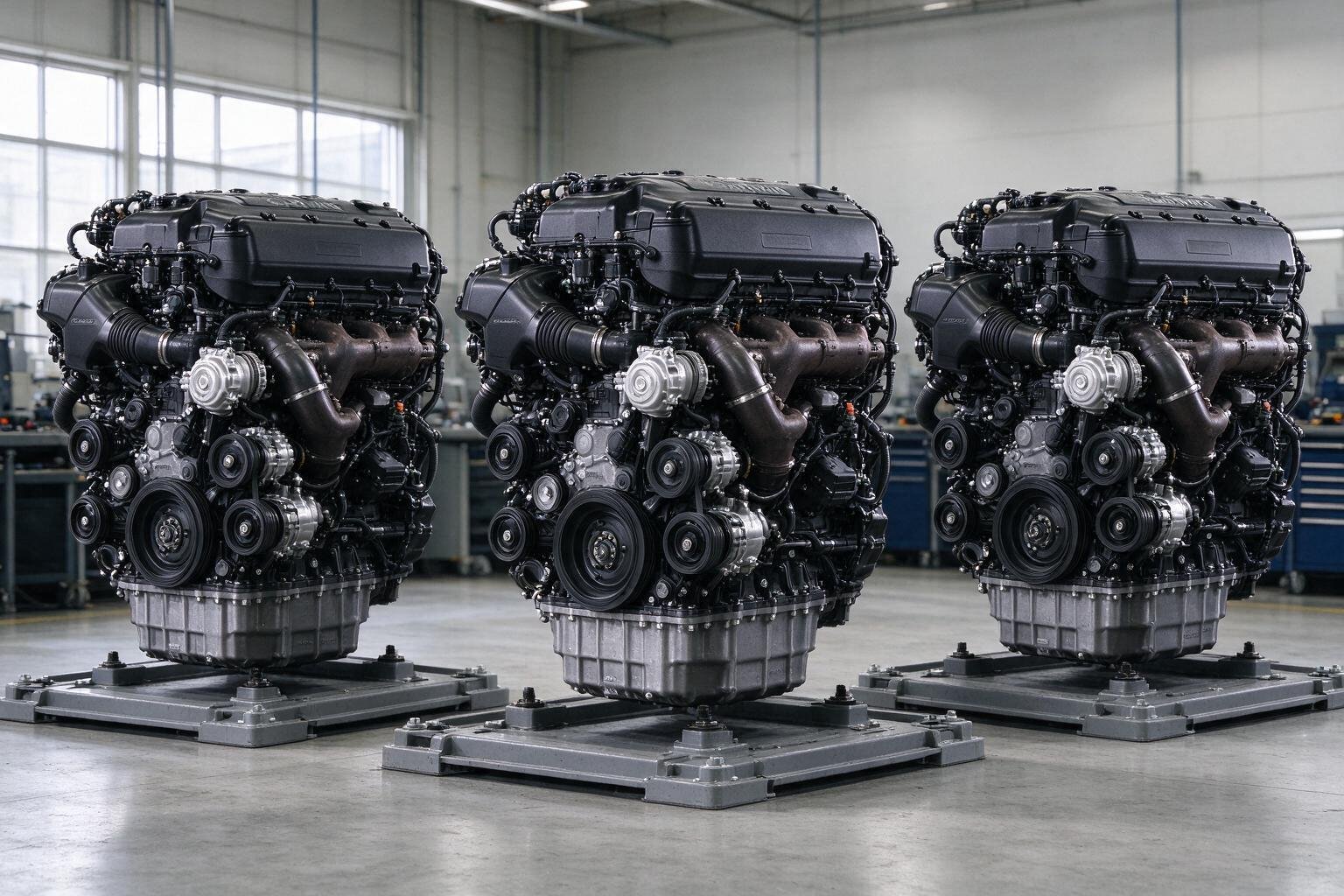
Any Cummins ISX12 engine assembly supplier comparison should begin with a clear definition of what the term “engine assembly” covers, because listings vary widely in content. The Cummins ISX12 is a 12-liter inline-six diesel engine used in heavy-duty truck and vocational applications, and assemblies for this platform are offered in several forms depending on the seller.
A complete drop-in assembly generally includes the cylinder block, crankshaft, pistons, connecting rods, cylinder head, camshaft, and oil pump. Depending on the supplier’s configuration, it may also include the fuel system and turbocharger. A long block omits external components such as the turbocharger, injectors, ECM, and accessory drives. Buyers should confirm exactly which items are included before comparing prices, since two listings described as “complete” may differ substantially in content.
Configuration also matters. Power ratings, emissions calibration (EPA model year), and transmission interface vary across the ISX12 line, so an assembly must match the original engine’s CPL (Critical Parts List) number. A mismatched CPL can create fitment and calibration problems that are costly to resolve after delivery.
Suppliers fall into three broad categories:
Supplier Categories and How They Differ
The Cummins ISX12 aftermarket is supplied through five broad categories, each with distinct commercial and technical characteristics.
Genuine Cummins Assemblies
Genuine Cummins assemblies carry the highest price and the most consistent documentation. Buyers receive CPL-specific part numbers that tie the assembly to a defined configuration, along with traceable serial data. This documentation is the primary differentiator; it supports warranty claims and service parts matching without ambiguity.
Cummins ReCon Remanufactured Units
ReCon units are built to Cummins specifications and typically carry a Cummins-backed warranty. Availability is often exchange-based, meaning the buyer must return a rebuildable core to complete the transaction. Core acceptance criteria and exchange pricing should be confirmed before ordering, as core condition directly affects total cost.
Independent Rebuilders
Independent rebuilders vary widely. Some follow OEM torque and tolerance specifications and provide documented machining records, such as line bore and deck surface measurements. Others perform minimal reconditioning, replacing only worn parts without restoring dimensional accuracy. Requesting the build sheet and machining documentation separates the two.
Aftermarket Assemblers
Aftermarket assemblers may use new or reconditioned components of mixed origin. Buyers should request component-level origin disclosure, especially for the block, crankshaft, and head, since these three items dominate assembly cost and service life.
Brokers and Trading Companies
Brokers resell units from multiple sources. They add logistics convenience but usually add a layer between the buyer and the actual builder, which can complicate warranty administration and traceability.
| Category | Price Level | Documentation | Warranty | Typical Availability |
|---|---|---|---|---|
| Genuine Cummins | Highest | CPL part number, serial trace | Cummins-backed | Order-based |
| Cummins ReCon | High | Cummins specification | Cummins-backed | Exchange with core |
| Independent rebuilder | Varies | Varies by shop | Shop-specific | Build-to-order |
| Aftermarket assembler | Lower | Component origin on request | Assembler-specific | Stock or build-to-order |
| Broker | Varies | Limited | Source-dependent | Stock-dependent |
Core Charges, Exchange Programs, and Logistics
Remanufactured and exchange programs for the Cummins ISX12 typically require the buyer to return a serviceable core. The core charge is not incidental: on a complete 1,000 kg-plus assembly it can represent a significant share of total transaction value, so it should be evaluated as part of the landed cost rather than treated as a refundable deposit.
Core Acceptance and Hidden Costs
Acceptance criteria usually require a complete, non-cracked, non-seized block with a configuration matching the ordered unit. Buyers should obtain these criteria in writing before ordering, because rejection at inspection converts the core charge into a permanent cost. Return freight, inspection fees, and rejection risk on cores are frequently excluded from quoted prices and should be confirmed in writing alongside the quote.
Cross-Border Documentation and Packaging
Cross-border shipments require commercial invoices and correct HS codes, and often fumigation certificates or crating documentation depending on the destination country and packaging material. Packaging standards for an assembly exceeding 1,000 kg affect both freight class and insurance coverage; undersized crating or uncertified wood can delay clearance or void claims.
Lead Time Comparison
Lead time comparisons should separate build time from transit time. Reman exchange units may be available from stock, while custom builds can take weeks before shipment. A supplier quoting a short total lead time may be quoting stock availability only, with transit and core processing excluded.
| Cost or Lead Time Element | Typically Quoted | Often Excluded |
|---|---|---|
| Unit price | Yes | — |
| Core charge | Sometimes | Frequently |
| Return freight on core | Rarely | Yes |
| Inspection fees | Rarely | Yes |
| Build time | Often | — |
| Transit time | Sometimes | Frequently |
Documentation and Traceability to Request
A Cummins ISX12 assembly purchase should be evaluated on the paperwork the supplier can provide, not only on the hardware. The following documents are reasonable to request before acceptance.
Identification
The assembly should carry a serial number and CPL (Critical Parts List) number, both legible and recorded on the invoice and build documents. When the unit is built to match a specific truck, the original engine serial number should also appear so the replacement can be reconciled with the vehicle’s history and calibration.
Build sheet or bill of materials
A build sheet or BOM should list the major components (block, head, crankshaft, pistons, liners, camshaft, turbocharger, injectors, pumps) with part numbers and a status for each: new, reconditioned, or reused. Reused components should be identified individually, since service life and inspection criteria differ from new or reconditioned parts.
Machining records
For the block and head, request machining records where available: bore and hone dimensions with tolerances, deck flatness readings, and line bore checks. These establish whether the core was prepared to specification or simply cleaned and reassembled.
Dynamometer test report
A dyno report should show the break-in procedure, oil pressure at operating temperature, and rated power at specified RPM. Test data tied to the assembly serial number is more useful than a generic sheet.
Emissions configuration statement
A written statement should confirm the calibration matches the intended EPA model year and application. Mismatched calibration is a common source of registration and compliance problems.
| Document | Key data points |
|---|---|
| Identification | Assembly serial, CPL, original engine serial |
| Build sheet / BOM | Component part numbers, new/reconditioned/reused status |
| Machining records | Bore/hone dimensions, deck flatness, line bore |
| Dyno report | Break-in procedure, oil pressure, power at RPM |
| Emissions statement | Calibration, EPA model year, application |
Warranty and Service Terms to Compare
Warranty terms for a Cummins ISX12 assembly vary considerably between suppliers, and the headline figure is rarely the whole story.
Duration and coverage scope. Compare warranty length in hours or miles rather than months alone. A 12-month term means little if the engine accumulates 4,000 hours in that period. Confirm whether coverage is parts-only or includes labor, and whether labor is reimbursed at a published rate or a capped allowance. A longer parts-only term can be worth less than a shorter term that covers removal and refit labor.
Who performs the service. Establish whether warranty work must be done at a Cummins-authorized location, within the rebuilder’s own affiliated network, or at the buyer’s own shop with reimbursement. The third option offers the most flexibility for fleets with in-house technicians but usually requires prior authorization and documented labor rates.
Transferability and third-party installation. Confirm whether the warranty transfers to a subsequent owner, which affects resale value, and whether it remains valid when the unit is installed by a third party rather than the supplier or an authorized dealer. Some programs void coverage if installation is not performed or inspected by an approved facility.
Exclusions. Overheating, fuel contamination, incorrect installation, and unauthorized repairs are commonly excluded. Request the full exclusion list, not a summary.
Claims process. Ask for the claims procedure in writing, including required documentation (proof of installation, service records, fault codes, photographs) and typical response time for claim decisions.
| Item to confirm | What to request |
|---|---|
| Duration | Hours or miles, plus time limit |
| Coverage | Parts-only vs. parts and labor |
| Service location | Authorized, rebuilder network, or buyer shop |
| Transferability | Written confirmation |
| Exclusions | Full list |
| Claims | Documentation and response time |
Price Comparison Beyond the Unit Cost
The quoted unit price of a Cummins ISX12 assembly is only one line item in the total cost of ownership. Buyers comparing suppliers should build a cost model that includes the unit price, the core charge net of the credit returned when the old assembly is accepted, freight in both directions, duties and customs brokerage, installation labor, and the downtime cost incurred during the supplier’s lead time. A lower unit price with a long lead time or an unfavorable core policy can produce a higher total than a nominally more expensive quote.
Low-cost assemblies that use undocumented or unverified components often shift cost to the buyer through shorter service life, higher oil consumption, or unplanned rebuilds. The relevant comparison is cost per operating hour over the expected service interval, not the invoice price alone.
Quotes should be requested on a like-for-like basis: identical engine configuration, the same included components (injectors, turbocharger, oil pump, seals), the same warranty term and claims process, and the same delivery terms under defined Incoterms. Without this alignment, price differences are not meaningful.
For cross-border transactions, payment terms and escrow options affect risk. Milestone payments tied to pre-shipment inspection or third-party verification can reduce exposure. Volume buyers should also ask about supply consistency and the repeatability of build specifications across batches, including documented torque values, component part numbers, and test records.
| Cost element | What to verify in the quote |
|---|---|
| Unit price | Configuration and included components |
| Core charge | Credit amount and return conditions |
| Freight | Both directions, Incoterms stated |
| Duties | Responsibility and brokerage |
| Downtime | Lead time and installation schedule |
Inspection Checklist on Receipt
Receiving inspection of a Cummins ISX12 engine assembly should begin before the unit is moved into the shop, and every finding should be recorded against the purchase order and the supplier’s shipping documentation. The checks below apply whether the assembly is a new long block, a rebuilt assembly, or a used take-out.
Identification and Documentation
Verify the engine serial number and CPL (Critical Parts List) number stamped on the block against the purchase order, the supplier’s invoice, and any build sheet or test report provided. A mismatch in CPL can indicate a different configuration than ordered, including differences in pistons, injectors, turbocharger matching, or emissions calibration. Record both numbers exactly as stamped.
Shipping Damage
Inspect the assembly for damage that occurred in transit:
- Cracked or chipped exhaust and intake manifolds
- Bent or sheared mounting and manifold studs
- Dented or punctured oil pan
- Blocked, crushed, or missing port covers on coolant, oil, intake, and exhaust openings
- Bent flywheel housing flanges or damaged front gear housing
Bill of Materials and Parts Substitution
Confirm that all included components match the bill of materials: oil cooler, water pump, front cover, flywheel housing, and any accessories listed as part of the sale. Check for evidence of reused components, such as worn fasteners, residual gasket material, or mismatched paint and casting dates. Any substituted part should have been disclosed in writing before shipment.
Preservation and Moisture Exposure
Confirm that preservative oil is present in the crankcase and that cylinder bores and external machined surfaces carry storage protection. Look for rust bloom on bores, flywheel, or damper, and for water staining on the crate or pallet, which suggests moisture exposure during transit.
Documentation and Claims
Photograph all findings before signing the delivery receipt, note exceptions on the carrier’s paperwork, and file any damage or shortage claim within the supplier’s stated window.
Matching Supplier Type to Application
The appropriate Cummins ISX12 assembly source depends on how the engine will be used, not on unit price alone. Each supplier category carries different trade-offs in warranty terms, documentation, and component coverage.
Fleet operators with high utilization generally favor reman or genuine assemblies for predictable service life and warranty support. A documented remanufacturing process with a defined warranty period reduces downtime risk when vehicles run high annual mileage and service intervals are tightly scheduled.
Rebuilders and repair shops may prefer long blocks or short blocks to reuse existing external components and control cost. This approach requires the shop to verify that the existing intake, turbocharger, fuel system, and accessory drive components remain within specification for the replacement block.
Export and resale buyers should prioritize documentation completeness and configuration accuracy over lowest unit price. Serial number records, build sheets, emission configuration, and CPL data matter more than a marginal price difference when the engine will cross borders or be resold to an unknown end user.
Low-utilization or vintage equipment may justify independent rebuilders where OEM supply is limited or discontinued. In these cases, the buyer should confirm the rebuild specification and parts provenance, since original configuration data may be incomplete.
| Buyer type | Typical preference | Primary concern |
|---|---|---|
| High-utilization fleet | Reman or genuine assembly | Warranty support, predictable life |
| Rebuilder or repair shop | Long block or short block | Reuse of external components, cost |
| Export or resale | Fully documented assembly | Configuration accuracy, records |
| Low-utilization or vintage | Independent rebuilder | Availability, specification clarity |
In all cases, the buyer should confirm the supplier’s actual role (builder, remanufacturer, or reseller) and request references from comparable applications.