
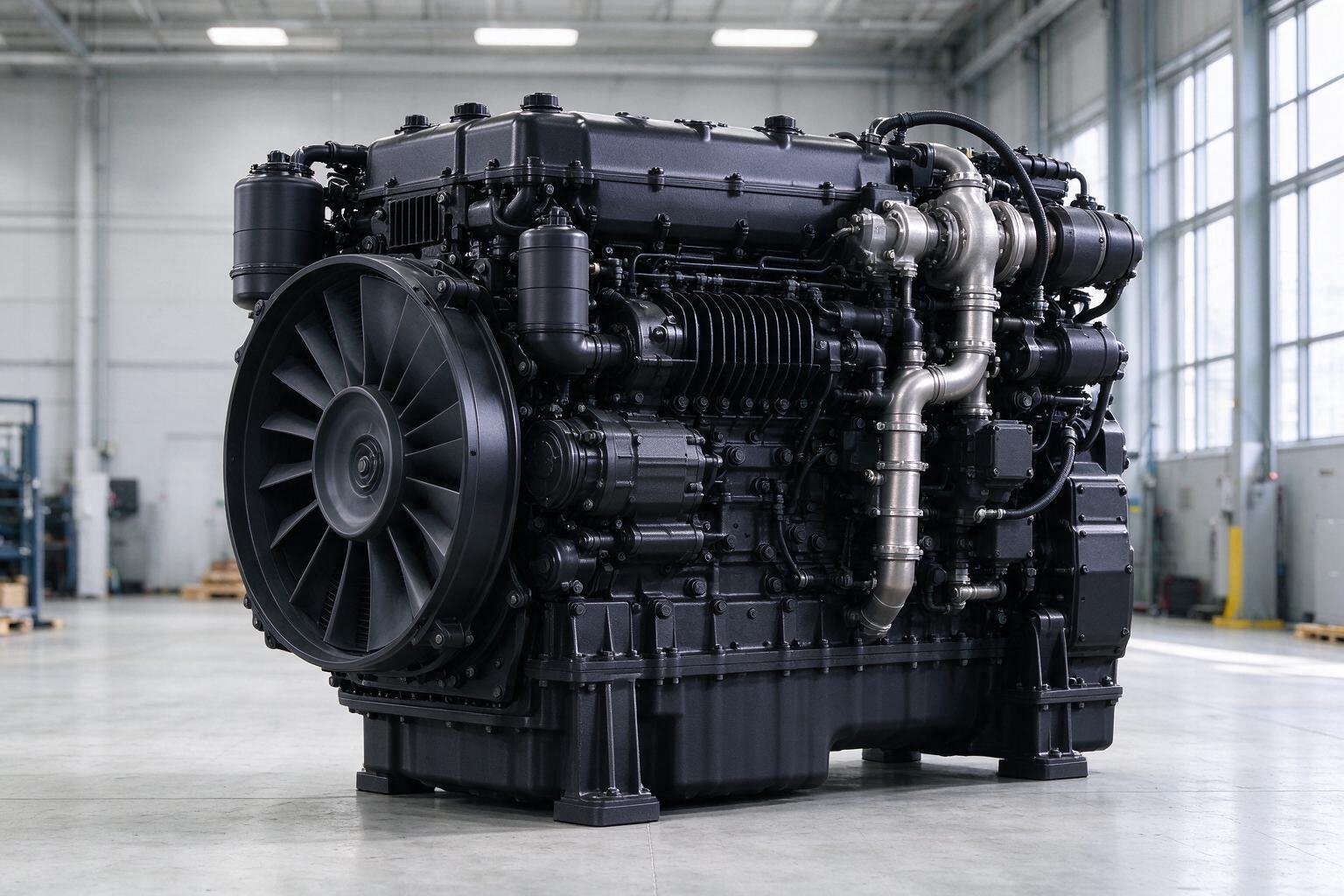
Understanding the QSK19 Engine Assembly
The QSK19 is a 19-liter, inline six-cylinder diesel engine from Cummins’ Quantum Series. It is used in mining haul trucks, rail equipment, marine propulsion, and heavy power generation, where continuous duty and high torque output are required. The platform is a common rebuild and replacement target because these applications accumulate hours quickly and downtime carries significant cost.
An engine assembly for the QSK19 is sold under several labels, and the scope of what is included varies by supplier. A long block typically includes the block, crankshaft, pistons, camshaft, and cylinder head. A complete assembly adds the fuel system, turbocharger, and electronics, and may be offered as a drop-in unit ready for installation. Buyers should confirm exactly which scope a listing covers before comparing prices, since a long block and a complete running assembly differ substantially in cost and installation labor. A low price on a listing that omits the fuel system and turbocharger is not comparable to a complete drop-in quote.
Ratings for the QSK19 range roughly from 600 to 800 hp depending on application and CPL (Critical Parts List). The assembly must match the intended duty rating, because fuel system calibration, piston configuration, and turbocharger matching differ across ratings. Installing an assembly built to a lower rating in a high-demand application can lead to reduced service life or immediate performance shortfalls.
| Assembly Scope | Typical Contents | Installation Consideration |
|---|---|---|
| Long block | Block, crankshaft, pistons, camshaft, cylinder head | Reuse of fuel system, turbocharger, and electronics |
| Complete assembly | Long block plus fuel system, turbocharger, electronics | Drop-in installation, higher unit cost |
Buyers should obtain the CPL and rating for the donor or replacement assembly and verify it against the equipment’s original specification before purchase.
Configuration Codes and CPL Identification
Every Cummins QSK19 engine carries a Control Parts List (CPL) number. The CPL defines the specific combination of pistons, injectors, turbocharger, camshaft, and governor used in that build. Because the QSK19 was produced in numerous ratings and emissions configurations, the CPL is the practical key to identifying which components belong on a given assembly.
The engine serial number (ESN) is the primary identifier. The CPL is derived from the ESN and determines which parts are correct for the assembly. A buyer working from the ESN alone can resolve the CPL through Cummins parts literature, but a seller-supplied CPL should still be cross-checked rather than accepted at face value.
CPL matching matters because two QSK19 assemblies of the same 19-liter displacement can differ in compression ratio, injection timing, and aftercooler configuration. These differences affect piston design, injector part numbers, camshaft profile, and turbocharger matching. Fitting components from a different CPL can produce incorrect fueling, thermal load, or combustion timing, even when the parts physically bolt together.
Before purchase, request both the ESN and the CPL from the seller and verify them against Cummins parts literature. Where possible, confirm the CPL plate or stamping on the engine itself and compare it with the paperwork. An assembly offered without a verifiable ESN and CPL carries configuration risk that is difficult to resolve after delivery.
| Identifier | Role |
|---|---|
| Engine serial number (ESN) | Primary identifier; source for CPL lookup |
| Control Parts List (CPL) | Defines pistons, injectors, turbocharger, camshaft, and governor configuration |
New, Remanufactured, and Used Assemblies
QSK19 assemblies are available in three condition tiers, and the choice between them is driven by budget, downtime tolerance, and documentation requirements rather than by any single specification difference.
New assemblies carry full warranty coverage from the OEM or an authorized distributor. They also carry the highest purchase price and the longest lead time, which can extend to weeks or months depending on build slot availability and configuration. New units suit applications where a documented zero-hour baseline is required for warranty, insurance, or resale purposes.
Remanufactured assemblies are rebuilt to a defined specification, typically involving crankcase inspection, crankshaft regrinding or replacement, new bearings, pistons, liners, and a cylinder head refresh to published tolerances. Most reman programs include a warranty, often shorter than new but covering major components. Remanufactured units are common in fleet and mining operations where downtime cost dominates the purchase decision and a known rebuild specification is more valuable than a zero-hour history.
Used or take-out assemblies are the lowest-cost option but carry inspection risk. Buyers should obtain documented engine hours, service history, and the reason for removal. A take-out pulled for a chassis upgrade differs materially from one removed after a bottom-end failure. Compression test results, oil analysis records, and borescope images reduce risk but do not eliminate it.
Core exchange terms differ by supplier. Some require a rebuildable core return within a stated window, with credit withheld or reduced if the core fails inspection. Others price the core into the sale and do not require a return. Confirm core terms in writing before ordering, since core charges on a QSK19 can represent a meaningful share of the total transaction.
| Condition | Warranty | Relative Cost | Lead Time | Core Terms |
|---|---|---|---|---|
| New | Full | Highest | Longest | Typically none |
| Remanufactured | Defined, usually partial | Mid | Moderate | Often required |
| Used / take-out | As-is or limited | Lowest | Shortest | Usually none |
Inspection Points Before Purchase
A QSK19 assembly represents a significant capital outlay, and the inspection process should be treated as a condition assessment rather than a formality. The following checkpoints apply to complete running assemblies and to long blocks.
Cylinder Liners
Where bores are accessible, inspect each liner for vertical scoring, pitting, and cavitation damage on the coolant side. Liner protrusion above the deck should be measured against the OEM specification; incorrect protrusion affects head gasket sealing and fire ring loading. On assembled units with the head torqued down, request bore scope images as a minimum.
Crankshaft Journals
Main and rod journal dimensions must be verified with calibrated micrometers, and surface finish checked for scoring, taper, and ovality. A reground crankshaft requires matching undersize bearings, and the build sheet should state the grind size. Confirm that fillet radii were maintained during grinding, since incorrect radii concentrate stress.
Cylinder Heads
For remanufactured heads, request pressure test results and valve recession measurements. Recession beyond the service limit indicates seat wear that will affect valve lash and compression. Crack testing records for the injector bores and fire decks should also be available.
Turbocharger and Fuel System
On complete assemblies, record turbocharger and fuel system part numbers and confirm whether each component is new, remanufactured, or reused. Reused injectors and pumps should carry test data.
Documentation
| Item | Required content |
|---|---|
| Build sheet | Part numbers, serial numbers, component disposition |
| Dyno record | Break-in or test run data, if performed |
| Warranty | Terms, duration, coverage limits, in writing |
Written warranty terms and traceable documentation are the baseline for any purchase decision.
Application Fit and Installation Considerations
The QSK19 has been produced in marine, rail, and mining configurations, and these variants are not mechanically interchangeable without accessory changes. Mounting arrangements, cooling system routing, and exhaust configuration differ by application. A marine assembly typically uses a heat exchanger or keel-cooling circuit and a wet exhaust manifold, while a mining unit generally relies on a remote radiator and a dry exhaust stack. Rail variants may use different front-end accessory drives and mounting feet. Buyers should identify the donor application of an assembly before assuming it will fit the target machine.
Flywheel housing and flywheel part numbers must match the driven equipment. SAE housing sizes and flywheel bolt patterns vary across ratings and applications, and a mismatch prevents coupling to the transmission, generator, or pump drive. Confirm the housing SAE size and flywheel tooth count against the driven equipment before purchase.
Electronic QSK19 units require the correct ECM calibration for the target rating. Calibration is typically loaded at installation or by an authorized service provider using the appropriate software and rating code. An assembly removed from a different rating will not deliver the intended power curve until recalibrated.
Handling equipment must be verified against assembly weight and lifting points. The QSK19 dry weight is approximately 1,900 kg (4,200 lb), and the centre of gravity shifts with the accessory package fitted.
| Check | Detail |
|---|---|
| Application variant | Marine, rail, or mining accessory configuration |
| Flywheel housing | SAE size and bolt pattern match |
| Flywheel | Tooth count and coupling match |
| ECM calibration | Correct rating code for target output |
| Dry weight | Approximately 1,900 kg (4,200 lb) |
| Lifting points | Confirmed against assembly and lifting gear |
Evaluating Suppliers
A QSK19 assembly is a high-value purchase, and supplier due diligence should extend beyond price and availability. Buyers should request the seller’s rebuild specification in writing. This document should state the machining tolerances applied to the block, crankshaft, and connecting rods, identify the source of major components (genuine Cummins, OEM-equivalent, or aftermarket), and describe the testing performed before shipment. A dynamometer run-in with recorded oil pressure, blow-by, and fuel delivery data is a reasonable expectation for a unit of this class.
Warranty terms warrant close reading. Buyers should confirm the duration, whether coverage includes labor or parts only, and any geographic restrictions that could limit claims outside the seller’s region. A warranty that excludes removal and reinstallation costs shifts significant expense to the buyer.
Technical support is another differentiator. Suppliers should be able to assist with installation guidance, torque specifications, and calibration of the engine to the application, whether that is a haul truck, genset, or marine drive. A supplier unable to answer application-specific questions before the sale is unlikely to provide meaningful support afterward.
References from buyers running comparable applications are more useful than generic testimonials. Ask for contact details of customers with similar duty cycles and ask those references about failure rates and warranty response.
Finally, confirm logistics: crating standards, lifting points, freight terms, and insurance coverage for a unit weighing several thousand pounds. Specify who bears risk during transit and document the agreed terms in the purchase order.
| Verification item | What to request |
|---|---|
| Rebuild specification | Tolerances, parts sources, test records |
| Warranty | Duration, labor coverage, territory limits |
| Technical support | Installation and calibration contacts |
| References | Buyers in similar applications |
| Shipping | Crating, insurance, Incoterms |
Cost Factors and Lead Time
QSK19 assembly pricing is driven primarily by four variables: assembly scope, reman versus new, CPL rarity, and core requirements. A long block and a complete drop-in assembly sit at very different price points, so buyers should confirm exactly what is included (block, crank, rods, pistons, heads, and accessory drives) before comparing quotes. Remanufactured assemblies typically cost less than new, but the gap narrows for low-volume CPLs where core availability is thin. CPL rarity matters because less common ratings carry higher build costs and longer sourcing windows for correct pistons, injectors, and calibration hardware. Core requirements also affect net cost; refundable core charges vary by supplier, and cores with cracks, spun bearings, or mismatched components may be rejected or downgraded.
Lead times for remanufactured QSK19 assemblies commonly run several weeks from order to shipment. Specialized ratings and rare CPL configurations can extend beyond that window, particularly when specific fuel system or emissions hardware must be matched. Buyers scheduling downtime should request a written lead time rather than relying on general estimates.
Freight is a significant line item for a unit of this weight and should be quoted explicitly, including liftgate, crating, and residential or jobsite delivery where applicable. Assuming freight is included in the assembly price is a common budgeting error.
Total cost of ownership should extend beyond the assembly price to installation labor, calibration or ECM programming, fluids, and the expected service interval for the chosen rating. A lower-priced assembly with a shorter service interval can cost more over the engine’s life than a higher-priced unit with documented rebuild specifications.
Documentation and Warranty Checklist
Documentation is the buyer’s primary evidence that a Cummins QSK19 engine assembly matches the specification ordered and that warranty coverage is enforceable. Each item below should be obtained and retained before the assembly is released for installation.
Engine Identification
Request the engine serial number (ESN), the control parts list (CPL), and the build date in writing on the purchase invoice or a signed specification sheet. The ESN identifies the individual assembly and ties it to Cummins build records. The CPL defines the specific parts configuration, including pistons, injectors, turbocharger, and governor components. A mismatch between the CPL on the invoice and the data plate on the assembly is grounds to hold the shipment. Record the build date because it affects warranty eligibility and the applicability of service bulletins.
Warranty Terms
Confirm the warranty start date, the coverage duration in months or hours (whichever occurs first), and the claim submission process. The start date is typically tied to the in-service date or the delivery date, and the two should be stated explicitly rather than inferred. Ask which party adjudicates claims, what documentation a claim requires, and whether labour is reimbursed. Warranty terms that reference only the seller, without naming the administrator and the escalation path, are difficult to enforce.
Test Records
Where dynamometer results, run-in data, or fuel-setting records are provided, retain copies with the engine file. These records document the assembly’s condition at dispatch and support later diagnostics.
Market Compliance
Verify that the assembly meets the emissions standard or engine classification required in the destination market. Tier ratings, fuel-system configuration, and certification labels vary by jurisdiction, and a correctly built engine for one market may not be accepted in another.
| Item | Record to Retain |
|---|---|
| ESN and CPL | Invoice, data plate photo |
| Build date | Build record or invoice |
| Warranty terms | Written policy with start date |
| Test records | Dyno or run-in sheet |
| Emissions classification | Certification label or statement |