
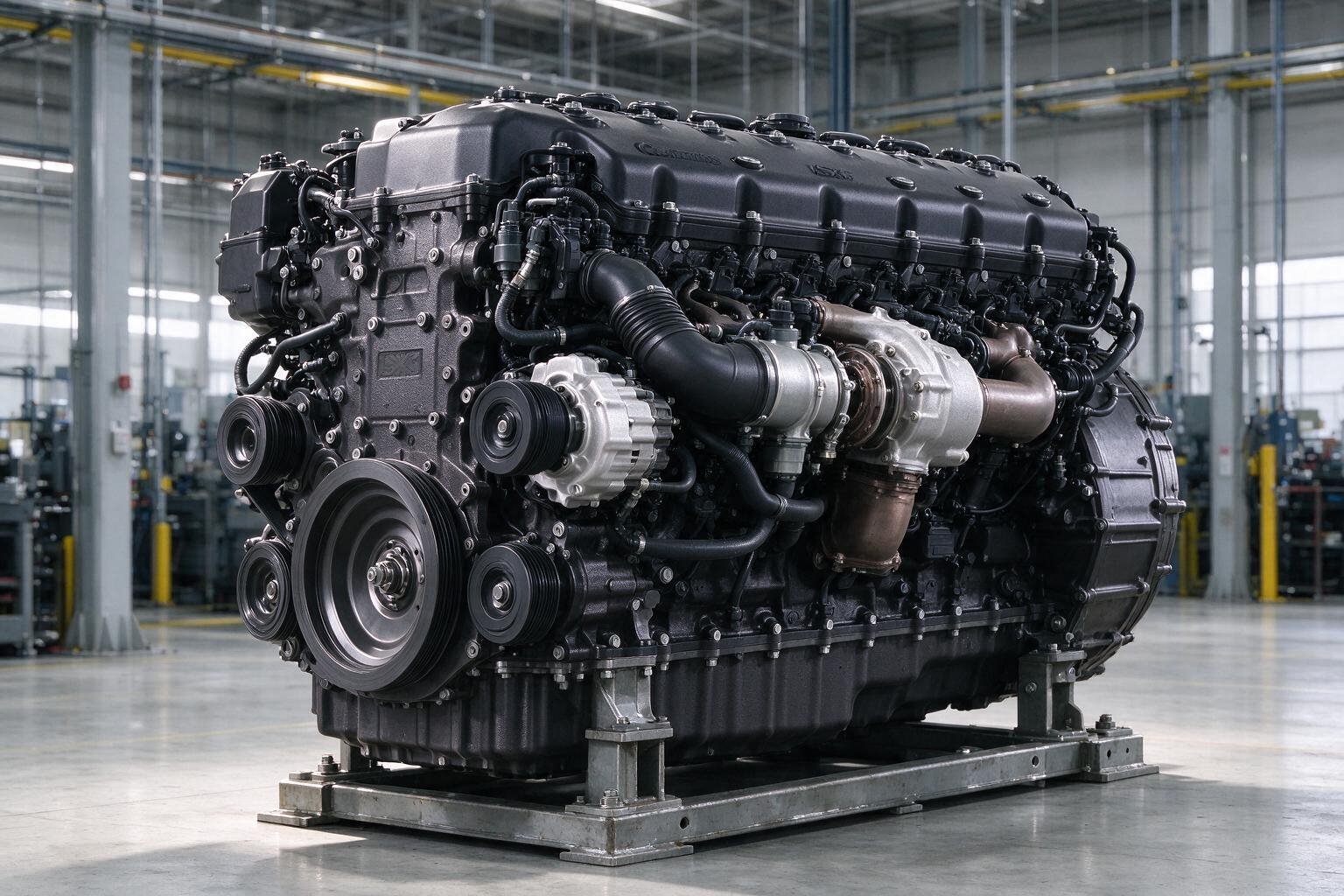
Understanding the Cummins ISX15 Engine Platform
This Cummins ISX15 engine assembly buying guide covers a 15-liter inline-six diesel engine produced by Cummins from 2007 to 2016 as the successor to the ISX. Use this Cummins ISX15 engine assembly buying guide to understand a platform designed for heavy-duty on-highway use that became one of the most common powerplants in Class 8 trucks during its production run. The engine uses a single overhead camshaft, four valves per cylinder, and a high-pressure common rail fuel system, with displacement of approximately 912 cubic inches (14.9 liters).
The engine was offered in multiple configurations to suit different duty cycles. Ratings ranged from 400 to 600 hp, with torque outputs from 1,450 to 2,050 lb-ft. Torque peaks typically fall in the 1,000–1,200 rpm range, while governed speed is around 2,000 rpm. Higher ratings were generally paired with automated manual or manual transmissions in long-haul service.
Emissions compliance shaped the platform’s evolution. The 2007 EPA standards were met using cooled exhaust gas recirculation (EGR) and a diesel particulate filter (DPF). The 2010 EPA standards introduced selective catalytic reduction (SCR), which required diesel exhaust fluid (DEF) and allowed retuning of the combustion strategy. Engines built between these milestones differ in aftertreatment architecture, EGR components, and calibration, so assembly identification matters when sourcing parts.
| Production Period | Emissions Standard | Key Aftertreatment |
|---|---|---|
| 2007–2009 | EPA 2007 | Cooled EGR, DPF |
| 2010–2016 | EPA 2010 | EGR, DPF, SCR with DEF |
The ISX15 is widely used in heavy-duty trucks, particularly vocational and long-haul applications. Its service footprint means rebuild and assembly components remain in demand, and identifying the specific build year and rating is essential before ordering parts.
Common ISX15 Engine Assembly Configurations
ISX15 engine assemblies are not interchangeable across all applications. Three variables determine whether a given assembly will work in a specific chassis: model year, horsepower rating, and emissions control system. Each affects compatibility with the vehicle’s ECM calibration and aftertreatment hardware.
Emissions System by Model Year
The 2007–2009 ISX15 models use a cooled exhaust gas recirculation (EGR) system without selective catalytic reduction (SCR). These assemblies do not require diesel exhaust fluid and are paired with an ECM calibration written for EGR-only operation. The 2010–2016 models add SCR to the emissions package and require DEF. Installing an early assembly in a 2010-or-later chassis leaves the SCR system without a compatible control strategy, and the reverse creates calibration and dosing faults. The ECM and aftertreatment components must match the emissions generation of the assembly.
Application-Specific Builds
Assemblies are configured for distinct duty cycles. On-highway truck versions carry ratings and accessory drives suited to highway use. Off-highway equipment versions may differ in governor settings, cooling connections, and mounting points. Power generation builds typically run at fixed speeds and use different fuel and control hardware. A truck assembly is generally not a drop-in replacement for a generator or excavator build.
Verifying the Build
The engine serial number (ESN) is the definitive identifier of an assembly’s build specification. The ESN decodes to the original horsepower rating, emissions configuration, and application. Buyers should obtain the ESN from the seller and confirm it against the data plate and, where possible, Cummins records before purchase. A visual match alone does not confirm ECM or aftertreatment compatibility.
Key Inspection Points for Used or Remanufactured Assemblies
A used or remanufactured ISX15 assembly should be evaluated against measurable criteria rather than appearance alone. The checks below address the failure modes most often reported on this platform.
Cylinder Liners and Pistons
Cylinder liner protrusion must be measured at multiple points around each liner and compared with the OEM specification, typically in the range of 0.003 to 0.006 in (0.08 to 0.15 mm), depending on the build. Inconsistent protrusion suggests a deck that has been machined incorrectly or liners that have shifted. Inspect liner bores for scoring, pitting, and the polished ring travel zone at top dead center. Piston ring side clearance and end gap should be checked; excessive gap indicates bore wear, while stuck or broken rings point to overheating or poor oil control.
Camshaft and Followers
Cam lobes and roller followers should be examined for pitting, spalling, and edge wear. Some ISX15 build ranges have documented cam and follower wear issues, so lobe lift and base circle runout should be verified where tooling allows.
EGR and Oil Coolers
Pressure-test the EGR cooler and oil cooler, and inspect for internal coolant passage corrosion. A failed cooler can introduce coolant into the intake or oil system, so any evidence of contamination warrants rejecting the assembly or budgeting for replacement.
Aftertreatment Components
Inspect the DPF for ash loading and substrate cracking, and check the SCR catalyst for blockage, melt damage, or contamination. Documented backpressure readings are useful where available.
Documentation
Request service history, rebuild records, and oil analysis reports. Elevated iron, copper, or potassium levels in prior samples can indicate wear or coolant ingress that visual inspection may miss.
| Component | Check | Reject If |
|---|---|---|
| Liners | Protrusion, bore scoring | Out of spec or deeply scored |
| Cam/followers | Pitting, lobe lift | Spalling or lift loss |
| EGR/oil cooler | Pressure test | Leaks or corrosion |
| DPF/SCR | Blockage, cracking | Melted or blocked substrate |
Compatibility and Interchangeability Considerations
Cummins ISX15 engine assemblies are not universally interchangeable across model years, chassis, or applications. A replacement assembly that fits one truck may not physically mount or electronically integrate into another, so buyers should verify several interface points before purchase.
Physical Interfaces
Mounting points and front engine support locations vary between applications, including on-highway truck, vocational, and industrial configurations. Bell housing patterns must match the transmission or adapter being used. Accessory drives, including front gear train and accessory belt configurations, differ by rating and application, so pulley and bracket layouts should be compared against the original assembly.
Electronics and Emissions
The ECM and engine wiring harness must be compatible with the replacement engine’s calibration and emissions system. ISX15 engines were produced across multiple emissions phases, and calibrations, sensor sets, and aftertreatment strategies differ between them. An ECM from a different emissions configuration may not run the engine correctly, and harness connectors and pinouts should be confirmed against the intended ECM.
Transmission Interface
The flywheel housing and flexplate or flywheel should be confirmed against the intended transmission. Housing SAE sizes, starter mounting locations, and flexplate bolt patterns differ, and mismatches can prevent installation or cause starter alignment problems.
Cooling System
Higher horsepower ratings generally require greater heat rejection. Radiator core size, fan drive configuration, and coolant capacity may need adjustment when moving to a higher-rated assembly. Buyers should compare the replacement engine’s cooling requirements against the existing radiator and charge air cooler before installation.
| Interface | What to Verify |
|---|---|
| Mounting points | Front supports and bracket locations |
| Bell housing | Bolt pattern and SAE size |
| ECM and harness | Calibration, emissions phase, connectors |
| Transmission | Flywheel housing, flexplate pattern |
| Cooling | Radiator capacity, fan drive, heat rejection |
Remanufactured vs. Used vs. New Engine Assemblies
The three main supply paths for a Cummins ISX15 assembly differ in warranty coverage, upfront price, and risk profile.
Remanufactured Assemblies
Remanufactured assemblies are stripped to the block, inspected, and rebuilt to OEM specifications. Worn components are replaced or machined back to tolerance, and the assembly typically ships with a written warranty covering a defined mileage or hour interval. The upfront cost is higher than a used unit, but the warranty shifts a portion of the failure risk to the rebuilder. Buyers should confirm what the warranty covers, whether it includes labor, and which ISX15 ratings and CPL numbers the assembly is built to.
Used Assemblies
Used assemblies are generally sold as-is, with limited or no warranty. Condition varies widely, and service history is often undocumented. A thorough inspection is essential: check for cylinder liner pitting, head cracks, bearing wear, and evidence of overheating or coolant contamination. Where possible, request a borescope inspection, oil analysis records, and the donor engine’s serial number to verify the rating and configuration.
New Assemblies
New assemblies remain available for the ISX15, but cost can be prohibitive for older equipment, particularly when the engine’s residual value is low. Availability may also be limited for certain ratings and configurations, so lead times should be confirmed before committing to a repair schedule.
Total Cost of Ownership
Purchase price is only one input. Total cost of ownership includes installation labor, downtime, core charges, and the probability of follow-on repairs. A used assembly with no warranty can erase its price advantage if a second removal and installation is required.
| Option | Warranty | Upfront Cost | Inspection Burden |
|---|---|---|---|
| Remanufactured | Typically included | Higher | Low |
| Used | Limited or none | Lower | High |
| New | Manufacturer coverage | Highest | Low |
Sourcing and Documentation Best Practices
Buying a used or remanufactured Cummins ISX15 engine assembly requires the same discipline as any other high-value drivetrain component. The assembly is heavy, expensive to ship, and difficult to evaluate after the sale, so most of the risk is managed before payment.
Confirm the Engine Serial Number
The first step is to obtain the engine serial number (ESN) from the seller and confirm it matches the assembly being advertised. The ESN is stamped on the block and appears on the data plate. A mismatch between the advertised ESN and the unit on the pallet can indicate a swapped block, a misrepresented core, or a listing error. The ESN also allows the buyer to check the original build configuration, including the CPL (Critical Parts List), against the advertised specifications.
Request Remanufacturing Documentation
If the assembly has been remanufactured, request the full documentation package. This should include the process description, test results (such as dyno run data or leak and pressure test records), and the written warranty terms. Warranty terms should be reviewed for coverage period, what is excluded, and who performs the repair if a claim arises.
Verify the Seller and Inspect the Assembly
Check the seller’s reputation through references, transaction history, and business records. Confirm the return policy in writing before purchase, including who pays freight on a return. Where possible, inspect the assembly in person or request detailed, dated photographs of the block, head, front gear train, and mounting surfaces.
Plan Shipping and Handling
A complete ISX15 assembly weighs roughly 3,000 lb, so shipping must use a rated pallet or crate, proper blocking, and a carrier experienced with heavy freight. Confirm lift points, tie-down locations, and insurance coverage before the unit leaves the seller’s facility.
Installation and Commissioning Notes
Correct installation and commissioning of a Cummins ISX15 engine assembly determine both immediate start-up success and long-term durability. Installers should follow the manufacturer’s published installation guidelines throughout, including all torque specifications for mounts, exhaust connections, and accessory drives, along with the specified fluid requirements for coolant, engine oil, and aftertreatment diesel exhaust fluid. Deviating from these values can cause fastener fatigue, coolant cavitation, or premature bearing wear.
ECM Calibration
The ECM calibration must be updated to match the specific engine assembly and the vehicle configuration. A calibration that does not correspond to the assembly’s horsepower rating, emissions tier, and transmission interface can produce incorrect fueling, fault codes, and derate events. Confirm the calibration part number against the engine serial number before the first start.
Pre-Start Inspection
A thorough pre-start inspection is required before cranking the engine:
- Verify engine oil, coolant, and DEF levels against specification.
- Check belt tension and alignment on the accessory drive.
- Confirm all electrical connections, including the ECM harness, sensors, and battery cables, are seated and secure.
- Inspect fuel lines and cooling system connections for correct routing and tightness.
Break-In Monitoring
After installation, monitor engine performance closely through the break-in period. Check for oil, coolant, and fuel leaks at each inspection interval, and listen for abnormal noises such as injector knock, turbocharger whine, or exhaust manifold leaks. Log oil pressure and coolant temperature at operating load, and compare readings against the service manual limits. Any deviation should be investigated before the engine is placed into full service.
Regulatory and Emissions Compliance
Emissions certification is a primary constraint when sourcing a Cummins ISX15 engine assembly. The ISX15 was produced across multiple emissions tiers, from EPA 2007 through EPA 2013 and later configurations, and each tier corresponds to specific aftertreatment and calibration requirements. A buyer must confirm that the engine assembly’s certification matches the emissions standard applicable to the intended application and operating region.
Certification is application-specific. An engine originally certified for on-highway use under 40 CFR Part 86 is not automatically legal for off-highway or stationary applications. Off-highway installations typically fall under different regulatory provisions, and using an on-highway-certified assembly in an off-highway machine generally requires re-certification or a documented exemption. Buyers should obtain the engine’s original emissions label and certificate of conformity before committing to a purchase.
Aftertreatment completeness is equally important. ISX15 assemblies from 2007 onward rely on diesel particulate filters and selective catalytic reduction systems. A used assembly sold without the correct DPF, SCR catalyst, dosing module, and associated sensors may not meet its certified emissions profile, and substituting non-compliant components can create liability for the installer and operator.
| Verification Item | Purpose |
|---|---|
| Emissions label and certificate of conformity | Confirms certified tier and application |
| Aftertreatment component list | Confirms DPF, SCR, and dosing hardware are present and matched |
| ECM calibration part number | Confirms calibration matches certification |
| Modification and reflash records | Documents any deviation from original certification |
Maintaining records of certification, calibration, and any modifications supports regulatory audits and resale documentation. Incomplete records can complicate both compliance verification and future transactions involving the engine.